ZEISS Sigma 360 FE-SEM DVIA-ML1000 Installation Report
Contents
Overview
Following the installation of DVIA-ML1000 at Hangzhou(杭州), tuning and vibration measurement were performed.
Vibration measurement was conducted with the equipment in the Turned off state.
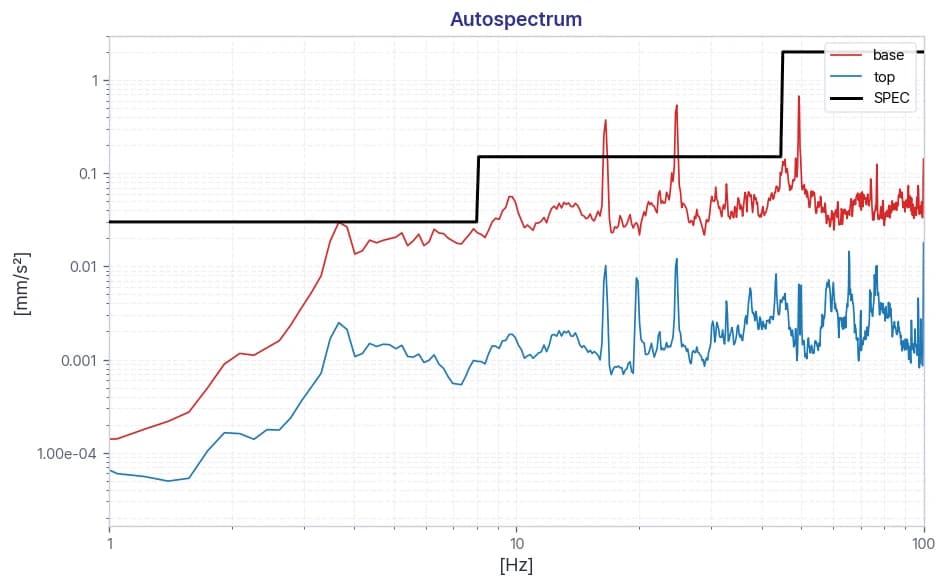
Data is represented in Autospectrum format and reference material on the vibration level is provided.
Vibration Isolation System Information
Model: DVIA-ML1000
Serial Number: 260617R6-1
Engineer
Younguk Kim · DAEIL SYSTEMS
Tuning Date
2026.09.11
End User
Zhejiang A&F University(浙江农林大学)
Number of Tuning Trial
1st
Site
Hangzhou(杭州)
Equipment
Manufacturer: ZEISS
Equipment: FE-SEM
Model: Sigma 360
Vibration Specification
Horizontal
| Frequency [Hz] | Allowable [mm/s² RMS] |
|---|---|
| 1 | 0.04 |
| 10 | 0.04 |
| 10 | 0.17 |
| 20 | 0.17 |
| 20 | 0.3 |
| 70 | 0.3 |
| 70 | 2 |
| 100 | 2 |
Vertical
| Frequency [Hz] | Allowable [mm/s² RMS] |
|---|---|
| 1 | 0.03 |
| 8 | 0.03 |
| 8 | 0.15 |
| 45 | 0.15 |
| 45 | 2 |
| 100 | 2 |
Equipment Condition
Turned off
Tuning Request
Conclusion
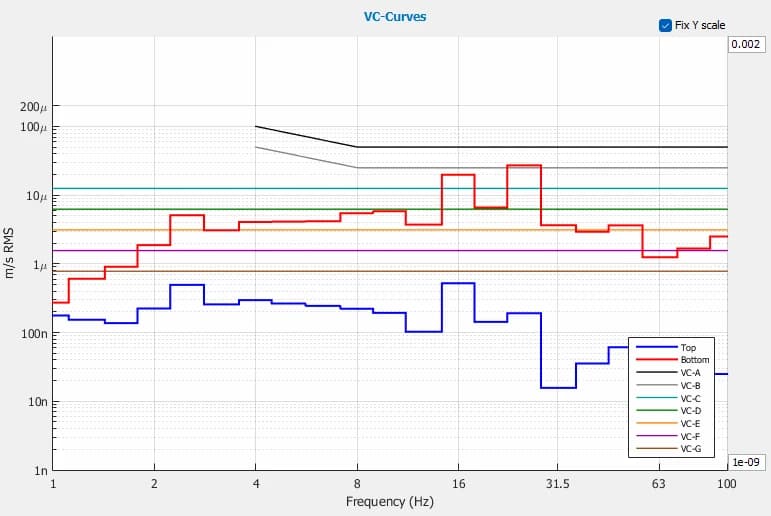
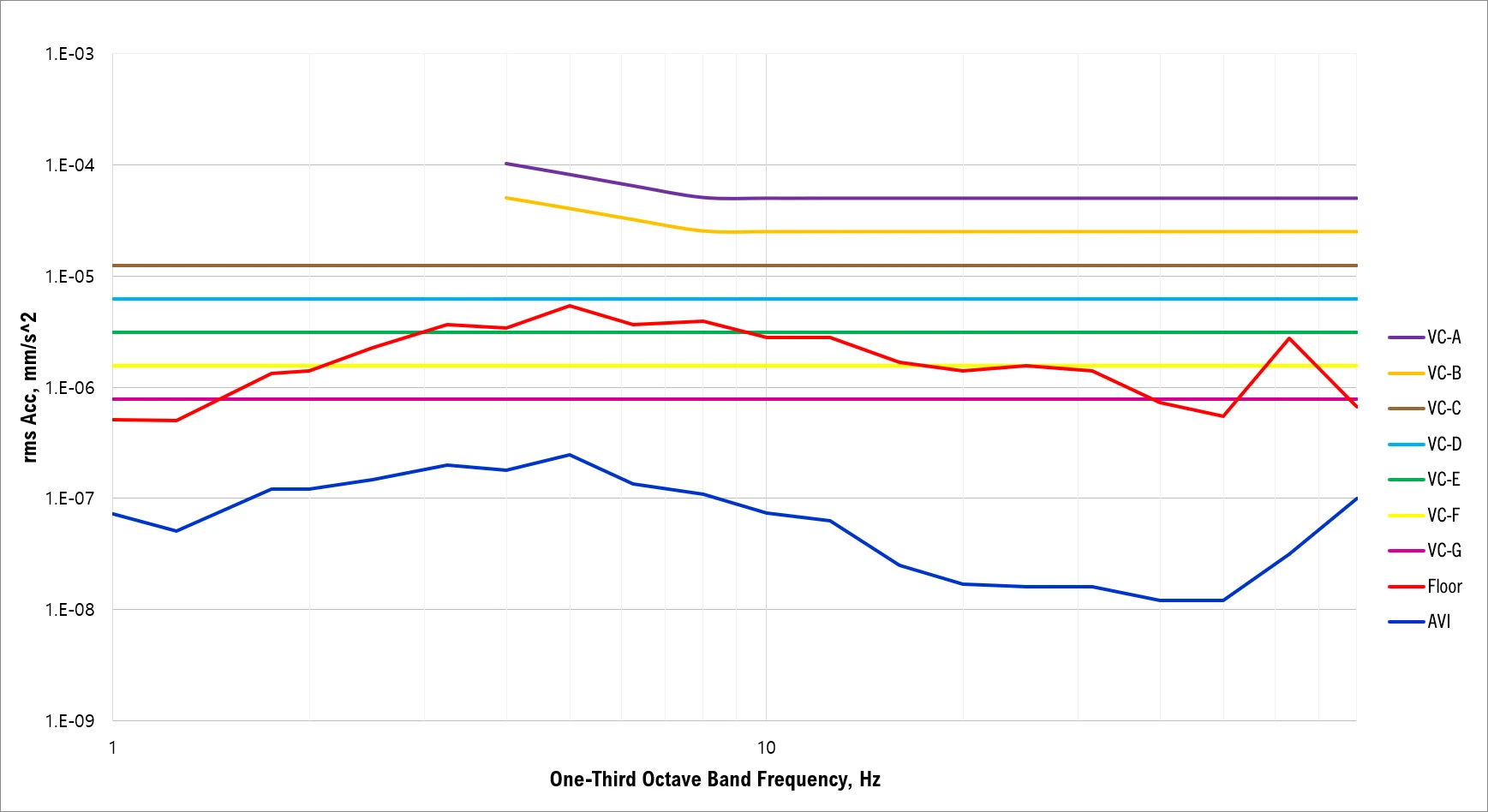
Vibration measurements were performed at two positions — the installation floor and the top surface of the DVIA-ML1000 active vibration isolation system — and evaluated against the criteria defined in Section 9.
At the commencement of tuning, the floor vibration was already measured below the VC-G criterion (approximately 100 nm/s), indicating that the installation environment itself represents an exceptionally low ambient vibration condition. Under such conditions, the input vibration available for the active isolation system to attenuate is inherently minimal; therefore, the customer's requirement of -20 dB attenuation over the 2–10 Hz range is physically difficult to achieve. This result is attributable to the characteristics of the measurement environment rather than to any performance deficiency of the isolation system.
Following completion of tuning, feedback was received from the customer that image instability was observed on the SEM despite the floor vibration being below VC-G. The following explanation was provided: the vibration specification required by the installed ZEISS Sigma 360 is at the VC-E level, and the measured environment satisfies this requirement with substantial margin. Accordingly, if image quality is still not achieved under these conditions, the cause is more likely to reside in the condition of the equipment itself rather than in the vibration isolation environment.
The End User subsequently verified the SEM image directly and provided confirmation, upon which the session was concluded.
Measurement Summary
| Measurement Point | Vibration Specifications | Axis | Result | |
|---|---|---|---|---|
| Floor | DVIA-ML1000 | |||
| 1. Floor 2. DVIA-ML1000 | See Section 9 | Vertical | ✓ PASS | ✓ PASS |
| Left to Right | ✓ PASS | ✓ PASS | ||
| Front to Back | ✓ PASS | ✓ PASS | ||
Measurement Data Obtained via UI Program
Vertical
Vertical — Autospectrum
Left to Right
Left to Right — Autospectrum
Front to Back
Front to Back — Autospectrum
Installation Photo
Equipment
Reference
The table below classifies vibration levels based on IEST-RP-CC012.2.
¹ As measured in one-third octave bands of frequency over the frequency 8 to 80 Hz (VC-A and VC-B) or 1 to 80 Hz (VC-C through VC-G).
² The detail size refers to the width in the case of microelectronics fabrication, the particle (cell) size in the case of medical and pharmaceutical research, etc. It is not relevant to imaging associated with probe technologies, AFMs, and nanotechnology.
The information given in this table is for guidance only. In most instances, it is recommended that the advice of someone knowledgeable about applications and vibration requirements of the equipment and processes be sought.
Share this Case Study
Case Study Information
Related Case Studies
Resonac Electronic Materials ZEISS Sigma 360 FE-SEM DVIA-ML1000 Installation Report
China XD Electric Co., Ltd. ZEISS Sigma 360 FE-SEM DVIA-ML1000 Installation Report