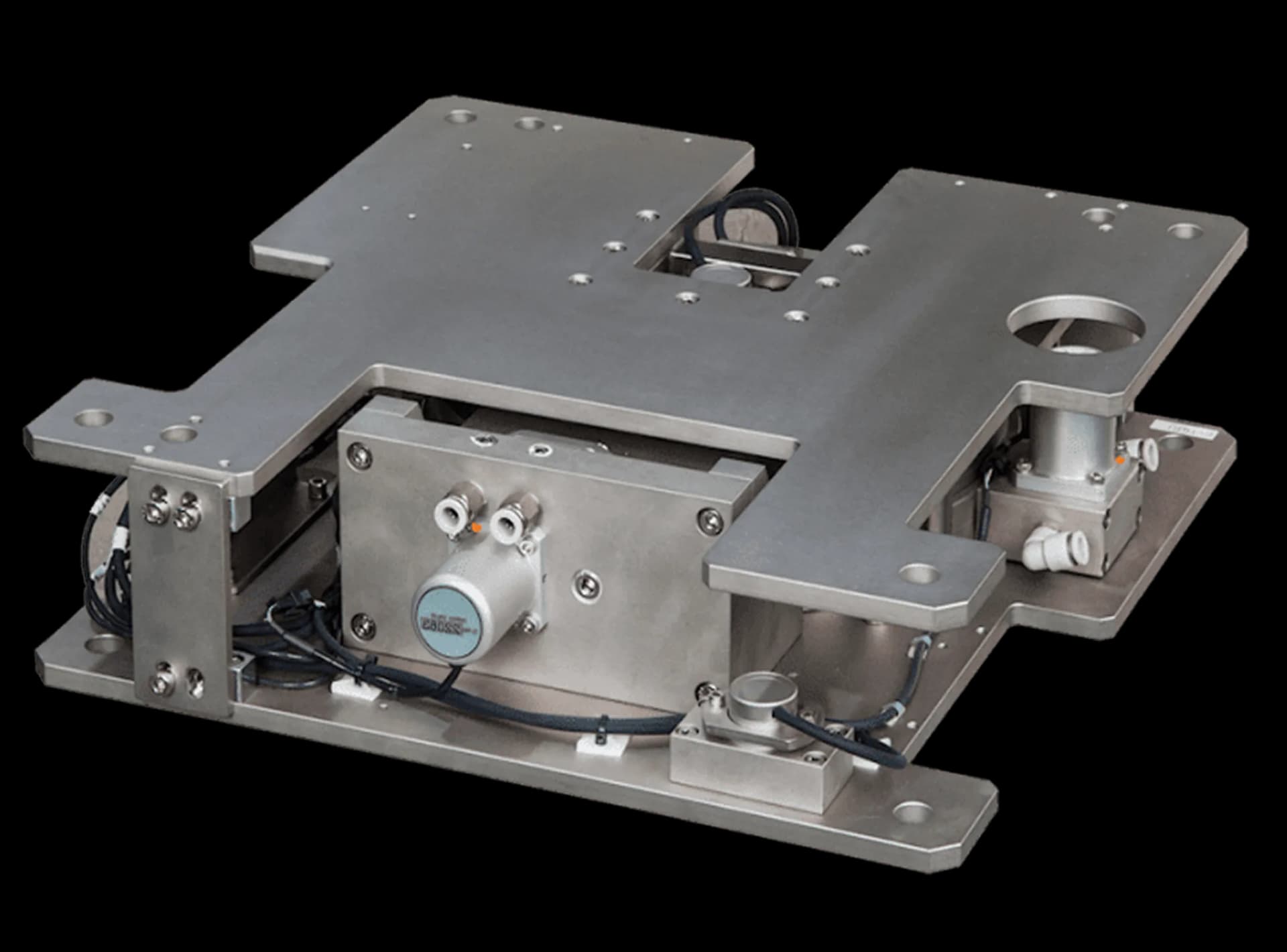
DVIA-P Series
Pneumatic Force.Semiconductor Precision.
Up to 20,000 kg payload. Pneumatic servo actuators. Ultra-fast settling. Engineered for semiconductor metrology.Up to 20,000 kg payload. Pneumatic servo actuators. Ultra-fast settling. Engineered for semiconductor metrology.
20t
Max Load capacityMax Load capacity
70%
Isolation at 2 HzIsolation at 2 Hz
6DOF
Every axis controlledEvery axis controlled
<1s
Settling timeSettling time
Designed for Metrology tools with nanometer-scale measurements.Designed for Metrology tools with
nanometer-scale measurements.
Nanometer-scale metrology lives at the noise floor of the building itself. A truck on the loading dock. A pump in the subfab. A door closing two bays away. Each event registers as motion under the column — and at sub-nanometer resolution, that motion becomes the measurement. The DVIA-P was engineered to remove that variable. Active pneumatic isolation cancels disturbance in real time, across all six degrees of freedom, before it ever reaches the stage. What the tool measures is the wafer. Not the floor it stands onNanometer-scale metrology lives at the noise floor of the building itself. A truck on the loading dock. A pump in the subfab. A door closing two bays away. Each event registers as motion under the column — and at sub-nanometer resolution, that motion becomes the measurement. The DVIA-P was engineered to remove that variable. Active pneumatic isolation cancels disturbance in real time, across all six degrees of freedom, before it ever reaches the stage. What the tool measures is the wafer. Not the floor it stands on
Promised performance.
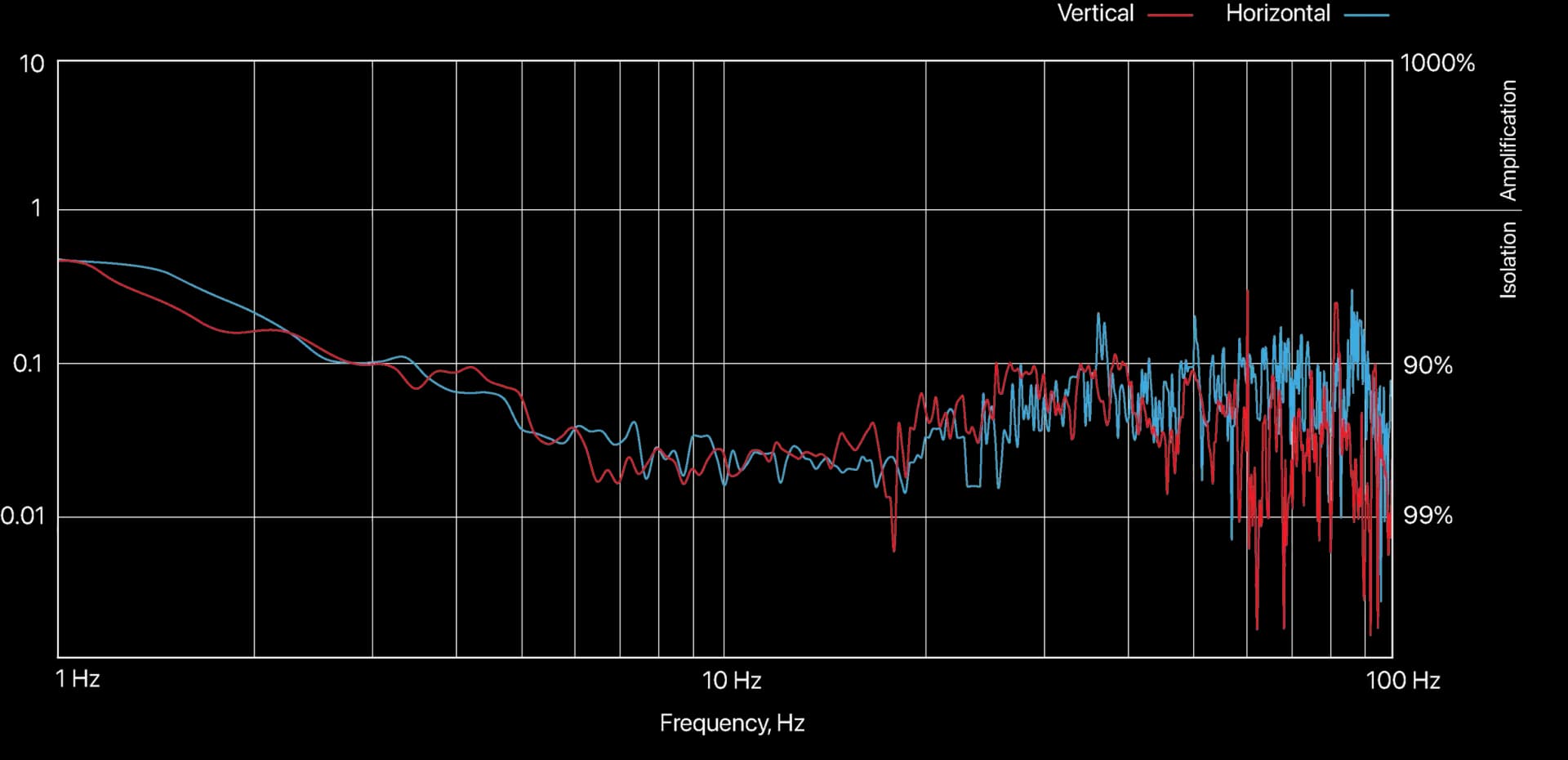
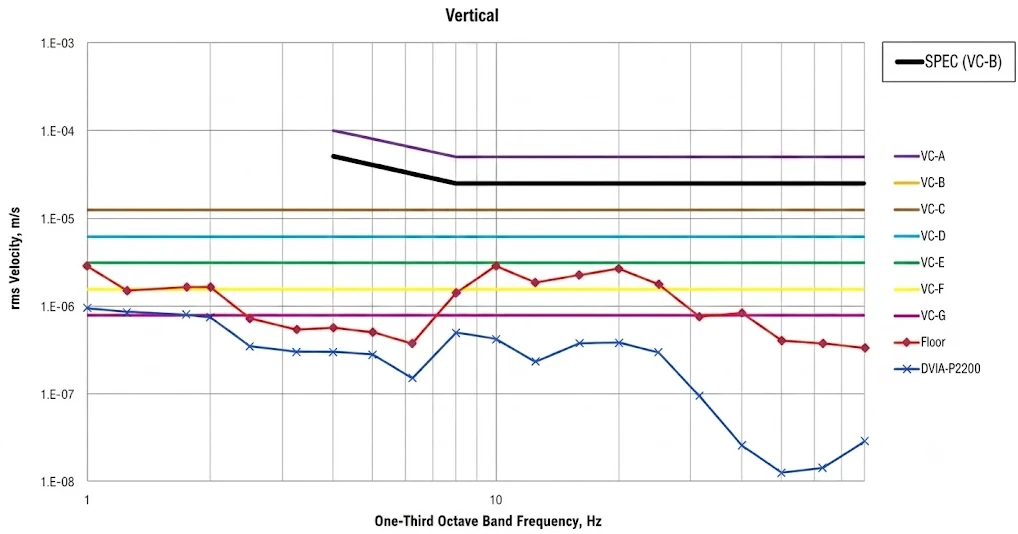
Isolation from 0.5 Hz.
Up to
90% at 4 Hz.
Up to
VC-G
Engineered for semiconductor
metrology at every node.
The DVIA-P supports the full range of front-end and mask-shop tools that define modern semiconductor manufacturing. Each configuration is engineered to the specific process the tool runs.
Engineered for semiconductor metrology at every node.Engineered for semiconductor
metrology at every node.
The DVIA-P supports the full range of front-end and mask-shop tools that define modern semiconductor manufacturing. Each configuration is engineered to the specific process the tool runs.The DVIA-P supports the full range of front-end and mask-shop tools that define modern semiconductor manufacturing. Each configuration is engineered to the specific process the tool runs.
CD-SEM
Critical Dimension SEM
Sub-nanometer linewidth measurement.
Sub-nanometer linewidth measurement.
CD-SEMs measure feature widths at advanced process nodes. Floor vibration broadens edge profiles and degrades repeatability. The DVIA-P delivers vibration-free wafer staging at the precision modern lithography demands.
CD-SEMs measure feature widths at advanced process nodes. Floor vibration broadens edge profiles and degrades repeatability. The DVIA-P delivers vibration-free wafer staging at the precision modern lithography demands.
Supported Manufacturers
Advantest · AMAT · Hitachi · Holon · DFJY
DR-SEM
Defect Review SEM
Catch every defect. Skip every false call.
Catch every defect. Skip every false call.
Defect review depends on stable beam-to-stage alignment as the SEM scans across the wafer. Imperceptible floor motion produces image artifacts indistinguishable from real defects. The DVIA-P holds the tool steady through full-wafer inspection cycles.
Defect review depends on stable beam-to-stage alignment as the SEM scans across the wafer. Imperceptible floor motion produces image artifacts indistinguishable from real defects. The DVIA-P holds the tool steady through full-wafer inspection cycles.
Supported Manufacturers
Advantest · AMAT · Hitachi · Holon · KLA
Photomask Repair
Photomask Repair
Repair to the original spec.
Repair to the original spec.
Mask repair tools deposit and remove material at the nanometer scale. Tool stability during the repair operation determines whether the mask returns to spec or fails final inspection. The DVIA-P keeps the repair head locked onto its target.
Mask repair tools deposit and remove material at the nanometer scale. Tool stability during the repair operation determines whether the mask returns to spec or fails final inspection. The DVIA-P keeps the repair head locked onto its target.
Supported Manufacturers
Bruker nm-VI · ZEISS MeRiT · Hitachi SIR Series
Reticle Inspection
Reticle Inspection System
Every die. Every defect. Zero noise.
Every die. Every defect. Zero noise.
Reticle inspection scans every micron of the photomask for defects that could replicate across millions of die. Vibration introduces image noise that masks real flaws. The DVIA-P delivers the mechanical silence reticle inspection demands.
Reticle inspection scans every micron of the photomask for defects that could replicate across millions of die. Vibration introduces image noise that masks real flaws. The DVIA-P delivers the mechanical silence reticle inspection demands.
Supported Manufacturers
ZEISS AIMS · KLA · AMAT
E-Beam Lithography
E-Beam Lithography
Precision patterns. Pristine edges.
Precision patterns. Pristine edges.
Pattern transfer at the nanoscale demands a vibration-free writing field. Floor disturbances translate directly into line- edge roughness and overlay error. The DVIA-P isolates the lithography column at the frequencies that matter most.
Pattern transfer at the nanoscale demands a vibration-free writing field. Floor disturbances translate directly into line- edge roughness and overlay error. The DVIA-P isolates the lithography column at the frequencies that matter most.
Supported Manufacturers
Raith · JEOL · Elionix
In-Line X-Ray
Automated X-Ray Inspection
Sub-micron CT. 24/7 on the production line.
Sub-micron CT. 24/7 on the production line.
In-line AXI resolves hidden solder joints in BGAs, flip-chips, and power packages through 3D CT reconstruction. At sub-micron detector resolution, any motion between source, sample, and detector during the scan becomes a volumetric artifact. The DVIA-P removes it.
In-line AXI resolves hidden solder joints in BGAs, flip-chips, and power packages through 3D CT reconstruction. At sub-micron detector resolution, any motion between source, sample, and detector during the scan becomes a volumetric artifact. The DVIA-P removes it.
Supported Manufacturers
Viscom · Omron · ViTrox · Nordson
Mask Aligner
Mask Aligner
Mask-to-wafer overlay, held steady.
Mask-to-wafer overlay, held steady.
Mask aligners require sub-micron registration between mask and wafer during exposure. Building vibration corrupts overlay accuracy and reduces yield. The DVIA-P delivers the stable platform exposure tools depend on.
Mask aligners require sub-micron registration between mask and wafer during exposure. Building vibration corrupts overlay accuracy and reduces yield. The DVIA-P delivers the stable platform exposure tools depend on.
Supported Manufacturers
SUSS MICROTECH · EVG
In-Line 3D AFM
In-Line 3D Atomic Force Microscopy
Picometer topography. 24/7 on the fab floor.
Picometer topography. 24/7 on the fab floor.
In-line 3D AFM delivers picometer-scale topography on the active fab floor — a physical probe against the wafer, 24/7. At a noise floor below 35 pm, any relative motion between tip and sample is the measurement error. The DVIA-P removes it.
In-line 3D AFM delivers picometer-scale topography on the active fab floor — a physical probe against the wafer, 24/7. At a noise floor below 35 pm, any relative motion between tip and sample is the measurement error. The DVIA-P removes it.
Supported Manufacturers
Bruker · Semilab · Nearfield Instruments
Every component. One purpose.
Every component. One purpose.Every component. One purpose.
Powerful force, by design.
Pneumatic servo valves counter disturbance in exact proportion to the payload. Pneumatic force scales with the load. From 500 kg metrology tools to 20,000 kg metrology tools, the response matches the tool and with Stage Feed-Forward, settling time collapses on every move.
Pneumatic servo valves counter disturbance in exact proportion to the payload. Pneumatic force scales with the load. From 500 kg metrology tools to 20,000 kg metrology tools, the response matches the tool and with Stage Feed-Forward, settling time collapses on every move.
Ultrafast settling time.
Motorized linear stages must settle to nanometer precision before imaging can begin. The DVIA-P's active control collapses that interval disturbances counter the moment they appear, and the platform returns to setpoint without delay. Less time waiting. More wafers measured.
Motorized linear stages must settle to nanometer precision before imaging can begin. The DVIA-P's active control collapses that interval disturbances counter the moment they appear, and the platform returns to setpoint without delay. Less time waiting. More wafers measured.
20,000 kg payload. No compromise.
Semiconductor metrology and inspection equipment can weigh tens of tons. The DVIA-P carries 20,000 kg without sacrificing a single axis. Full active isolation across all six. Maximum payload, uncompromised motion control.
Semiconductor metrology and inspection equipment can weigh tens of tons. The DVIA-P carries 20,000 kg without sacrificing a single axis. Full active isolation across all six. Maximum payload, uncompromised motion control.
Feedback corrects. Feedforward anticipates.
Feedback senses vibration on the isolated mass and counters it in real time. Feedforward reads the floor and cancels disturbances before they arrive. Together they deliver up to 90% vibration isolation at the low frequencies where semiconductor tools are most sensitive. Two control loops. One outcome.
Feedback senses vibration on the isolated mass and counters it in real time. Feedforward reads the floor and cancels disturbances before they arrive. Together they deliver up to 90% vibration isolation at the low frequencies where semiconductor tools are most sensitive. Two control loops. One outcome.
10 μm Position Accuracy.
10 μm. Held continuously. Position sensors track the platform without pause, and a digital signal processor returns the actuators to setpoint the moment drift appears. Hour after hour. No intervention. A reference engineered to be absolute.
10 μm. Held continuously. Position sensors track the platform without pause, and a digital signal processor returns the actuators to setpoint the moment drift appears. Hour after hour. No intervention. A reference engineered to be absolute.
Control, uncompromised.
Nineteen channels in. Ten channels out. Sixteen-bit sampling. Twenty-four-bit drive. The DVIA-P digital controller calculates every source of vibration the instant it appears, then commands the pneumatic actuators in real time. Synchronous. Continuous. The control architecture that defines the series.
Nineteen channels in. Ten channels out. Sixteen-bit sampling. Twenty-four-bit drive. The DVIA-P digital controller calculates every source of vibration the instant it appears, then commands the pneumatic actuators in real time. Synchronous. Continuous. The control architecture that defines the series.
The control architecture behind nanometer stability.The control architecture behind
nanometer stability.
System Architecture
DSP Feature Overview
Explore the advanced feedback and feed-forward mechanisms that ensure optimal vibration isolation performance.Explore the advanced feedback and feed-forward mechanisms that ensure optimal vibration isolation performance.
Stage Feed-Forward
If the isolation system has information about motorized linear stages in advance, the system can produce the force that equal in size to the force from dynamic linear stage motions in the opposite direction. As a result, the external force caused by the motorized linear stage is effectively minimized.If the isolation system has information about motorized linear stages in advance, the system can produce the force that equal in size to the force from dynamic linear stage motions in the opposite direction. As a result, the external force caused by the motorized linear stage is effectively minimized.
Acceleration Feedback
This feedback control system employs sensors and actuators to continuously detect vibrations which disturb the isolated payload, then reacts to minimize vibrations. The acceleration feedback system not only reduces from the floor but also effectively minimizes vibrations from the motorized linear stages.This feedback control system employs sensors and actuators to continuously detect vibrations which disturb the isolated payload, then reacts to minimize vibrations. The acceleration feedback system not only reduces from the floor but also effectively minimizes vibrations from the motorized linear stages.
Position Feedback
When the isolated base is disturbed by vibrations, the position feedback measures displacement through position sensors that transmit signals into the digital controller. After receiving the signals from the sensors, the digital controller drives actuators to return its original position, improving the position accuracy.When the isolated base is disturbed by vibrations, the position feedback measures displacement through position sensors that transmit signals into the digital controller. After receiving the signals from the sensors, the digital controller drives actuators to return its original position, improving the position accuracy.
Floor Feed-Forward
The floor feed-forward system filters the floor vibrations in a predefined way. The feed-forward control system is utilized when there are known factors such as a force applied to the isolated base, the data of ambient vibrations and information about equipment that needs to be isolated. Unlike the feedback control system, the feed-forward system analyzes dynamic characteristics of the equipment and tunes the feed-forward gains by the trial and error method to operate the actuators.The floor feed-forward system filters the floor vibrations in a predefined way. The feed-forward control system is utilized when there are known factors such as a force applied to the isolated base, the data of ambient vibrations and information about equipment that needs to be isolated. Unlike the feedback control system, the feed-forward system analyzes dynamic characteristics of the equipment and tunes the feed-forward gains by the trial and error method to operate the actuators.
Control in Six axes.
The DVIA-P controls all six degrees of freedom independently. Its
algorithm decouples each axis, eliminating cross-coupling. Sub-micron
translational and sub-microradian angular stability, maintained simultaneously.
Control in Six axes.
The DVIA-P controls all six degrees of freedom independently. Its algorithm decouples each axis, eliminating cross-coupling. Sub-micron translational and sub-microradian angular stability, maintained simultaneously.The DVIA-P controls all six degrees of freedom independently. Its algorithm decouples each axis, eliminating cross-coupling. Sub-micron translational and sub-microradian angular stability, maintained simultaneously.
FDC Native SECS/GEM.
The DVIA-P streams its full state into the fab's host system over native SEMI standards — HSMS (E37), SECS-II (E5), GEM (E30). As the passive equipment, the platform listens for the major semiconductor FABs. Every second, a single S6F1 trace message carries 30 SVIDs: FLOAT and ACTIVE lamps, three vibration alarms, communication faults, six displacement channels, nine acceleration channels. Internal polling: 500 ms. Trace transmission: 1 s. No middleware. No event chatter. Trace-only by design.
HSMS
TCP/IP transport. The platform listens as passive equipment; Smart-EAP connects as active. Select, Linktest, and Separate handled per E37 state machine. T3, T6, T7, T8 timers enforce the session.
TCP/IP transport. The platform listens as passive equipment; Smart-EAP connects as active. Select, Linktest, and Separate handled per E37 state machine. T3, T6, T7, T8 timers enforce the session.
SECS-II
Message format. S1F13/14 establishes communication, S2F23/24 starts the trace, and S6F1 streams the payload in big-endian — every second. W-bit fixed to 0. No host acknowledgment required.
Message format. S1F13/14 establishes communication, S2F23/24 starts the trace, and S6F1 streams the payload in big-endian — every second. W-bit fixed to 0. No host acknowledgment required.
GEM
Equipment model. Online and offline state, alarms, status, and trace data — the platform exposes itself as a standard GEM equipment to Smart-EAP. Monitoring only; FLOAT/ACTIVE control stays on the platform.
Equipment model. Online and offline state, alarms, status, and trace data — the platform exposes itself as a standard GEM equipment to Smart-EAP. Monitoring only; FLOAT/ACTIVE control stays on the platform.
30 SVIDs
Per S6F1 message: 7 status and alarm flags, 6 displacement channels (Z1, Z2, Z3, Y1, X2, Y3), and 9 acceleration channels — including Zb, Xb, Yb base. I4 integers, 10 μm and 10 μm/s² resolution.
Per S6F1 message: 7 status and alarm flags, 6 displacement channels (Z1, Z2, Z3, Y1, X2, Y3), and 9 acceleration channels — including Zb, Xb, Yb base. I4 integers, 10 μm and 10 μm/s² resolution.
FDC Native SECS/GEM.FDC Native SECS/GEM.
The DVIA-P streams its full state into the fab's host system over native SEMI standards — HSMS (E37), SECS-II (E5), GEM (E30). As the passive equipment, the platform listens for the major semiconductor FABs. Every second, a single S6F1 trace message carries 30 SVIDs: FLOAT and ACTIVE lamps, three vibration alarms, communication faults, six displacement channels, nine acceleration channels. Internal polling: 500 ms. Trace transmission: 1 s. No middleware. No event chatter. Trace-only by design.The DVIA-P streams its full state into the fab's host system over native SEMI standards — HSMS (E37), SECS-II (E5), GEM (E30). As the passive equipment, the platform listens for the major semiconductor FABs. Every second, a single S6F1 trace message carries 30 SVIDs: FLOAT and ACTIVE lamps, three vibration alarms, communication faults, six displacement channels, nine acceleration channels. Internal polling: 500 ms. Trace transmission: 1 s. No middleware. No event chatter. Trace-only by design.
HSMS
TCP/IP transport. The platform listens as passive equipment; Smart-EAP connects as active. Select, Linktest, and Separate handled per E37 state machine. T3, T6, T7, T8 timers enforce the session.
TCP/IP transport. The platform listens as passive equipment; Smart-EAP connects as active. Select, Linktest, and Separate handled per E37 state machine. T3, T6, T7, T8 timers enforce the session.
SECS-II
Message format. S1F13/14 establishes communication, S2F23/24 starts the trace, and S6F1 streams the payload in big-endian — every second. W-bit fixed to 0. No host acknowledgment required.
Message format. S1F13/14 establishes communication, S2F23/24 starts the trace, and S6F1 streams the payload in big-endian — every second. W-bit fixed to 0. No host acknowledgment required.
GEM
Equipment model. Online and offline state, alarms, status, and trace data — the platform exposes itself as a standard GEM equipment to Smart-EAP. Monitoring only; FLOAT/ACTIVE control stays on the platform.
Equipment model. Online and offline state, alarms, status, and trace data — the platform exposes itself as a standard GEM equipment to Smart-EAP. Monitoring only; FLOAT/ACTIVE control stays on the platform.
30 SVIDs
Per S6F1 message: 7 status and alarm flags, 6 displacement channels (Z1, Z2, Z3, Y1, X2, Y3), and 9 acceleration channels — including Zb, Xb, Yb base. I4 integers, 10 μm and 10 μm/s² resolution.
Per S6F1 message: 7 status and alarm flags, 6 displacement channels (Z1, Z2, Z3, Y1, X2, Y3), and 9 acceleration channels — including Zb, Xb, Yb base. I4 integers, 10 μm and 10 μm/s² resolution.
Monitoring · Alarm · LogMonitoring · Alarm · Log
A dedicated Windows monitoring application ships with every DVIA-P. It polls the DVIA-P controller over RS-232 in real time Vibration, Floating status, Position, Communication and latches every alarm in memory until the operator clicks Confirm. The instant something fires, the app jumps from minimized to topmost on the screen. No notification toasts. No chance of being missed. Every state change is timestamped and written to disk.A dedicated Windows monitoring application ships with every DVIA-P. It polls the DVIA-P controller over RS-232 in real time Vibration, Floating status, Position, Communication and latches every alarm in memory until the operator clicks Confirm. The instant something fires, the app jumps from minimized to topmost on the screen. No notification toasts. No chance of being missed. Every state change is timestamped and written to disk.
POLL
Real-time
Periodic Z2CR command over RS-232 at a configurable interval. The 16-bit DO state is read, decoded, and compared cycle-to-cycle. The controller runs at 57600 bps; the controller at 115200 bps with bit-inverted decoding.
Periodic Z2CR command over RS-232 at a configurable interval. The 16-bit DO state is read, decoded, and compared cycle-to-cycle. The controller runs at 57600 bps; the controller at 115200 bps with bit-inverted decoding.
LATCH
Alarm history
OR-latched alarm state. Transient events that fire and clear in a single polling cycle still appear in the history bar. The bar holds until the operator clicks Confirm.
OR-latched alarm state. Transient events that fire and clear in a single polling cycle still appear in the history bar. The bar holds until the operator clicks Confirm.
TOPMOST
Visual alert
The app stays minimized during normal operation. The instant any alarm fires, the window jumps to topmost. Confirm returns it to minimized — until the next event.
The app stays minimized during normal operation. The instant any alarm fires, the window jumps to topmost. Confirm returns it to minimized — until the next event.
LOG
Persistence
Every state change written to disk with a timestamp. Log rotation keeps the most recent 100 lines hot in log.txt; the previous 400 archive automatically. UTF-8 unicode throughout — no Korean character corruption.
Every state change written to disk with a timestamp. Log rotation keeps the most recent 100 lines hot in log.txt; the previous 400 archive automatically. UTF-8 unicode throughout — no Korean character corruption.
Turnkey.
From survey to sign-off.
Five engineered steps, delivered end-to-end by DAEIL SYSTEMS. From the first floor measurement to the final performance certification one supplier, zero handoffs.
01
Step 01
Site Survey.
Measure the floor before you isolate it.
Our engineers visit your fab to characterize floor vibration and the sub-structure beneath the metrology bay. We map vibration sources, identify weak access floors, and define the structural changes required to support your tool — before a single drawing is produced.
Deliverable
Floor vibration analysis report · Sub-floor structural assessment
Step 01
Site Survey.
Measure the floor before you isolate it.
02
Step 02
Custom Design.
Engineered to your fab. Confirmed before fabrication.
Based on the survey data, we design a custom concrete frame, concrete pads, and reinforced beams that replace the existing weak access floor and sit flush with the surrounding fab. Every drawing is reviewed and signed off by your team before manufacturing begins.
Deliverable
Engineering drawings · Customer sign-off
Step 02
Custom Design.
Engineered to your fab. Confirmed before fabrication.
03
Step 03
Manufacturing.
Built to spec. Inspected before it ships.
We fabricate the concrete substructure, the reinforced support beams, and the active isolation hardware in our facility. Every component is inspected against the approved drawings before it leaves the floor.
Deliverable
QA-verified components · Pre-shipment inspection
Step 03
Manufacturing.
Built to spec. Inspected before it ships.
04
Step 04
Installation.
On-site. End-to-end. Flush with your fab.
The DAEIL SYSTEMS installation team removes the existing access floor, positions the concrete frame and concrete pads, integrates reinforced structural beams, and installs the DVIA-P isolators. The completed assembly mounts flush with the surrounding fab floor, eliminating elevation differentials and preventing operational interference with adjacent tools.
Deliverable
Full structural integration · Tool-ready platform
Step 04
Installation.
On-site. End-to-end. Flush with your fab.
05
Step 05
Tuning & Verification.
Tuned by hand. Verified on-site.
DAEIL SYSTEMS field engineers tune the active isolation system to your specific tool. We measure floor vibration and isolated-mass vibration in parallel, then verify the system meets your metrology tool’s published vibration requirements before handover.
Deliverable
Vibration measurement report · Performance report
Step 05
Tuning & Verification.
Tuned by hand. Verified on-site.
No third-party subcontractors. No coordination overhead. From the first floor measurement to the final performance certification, DAEIL SYSTEMS engineers own every step.
Turnkey. From survey to sign-off.Turnkey.
From survey to sign-off.
Five engineered steps, delivered end-to-end by DAEIL SYSTEMS. From the first floor measurement to the final performance certification one supplier, zero handoffs.Five engineered steps, delivered end-to-end by DAEIL SYSTEMS. From the first floor measurement to the final performance certification one supplier, zero handoffs.
01
Step 01
Site Survey.
Measure the floor before you isolate it.
Deliverable
Floor vibration analysis report · Sub-floor structural assessment
Step 01
Site Survey.
Measure the floor before you isolate it.
02
Step 02
Custom Design.
Engineered to your fab. Confirmed before fabrication.
Deliverable
Engineering drawings · Customer sign-off
Step 02
Custom Design.
Engineered to your fab. Confirmed before fabrication.
03
Step 03
Manufacturing.
Built to spec. Inspected before it ships.
Deliverable
QA-verified components · Pre-shipment inspection
Step 03
Manufacturing.
Built to spec. Inspected before it ships.
04
Step 04
Installation.
On-site. End-to-end. Flush with your fab.
Deliverable
Full structural integration · Tool-ready platform
Step 04
Installation.
On-site. End-to-end. Flush with your fab.
05
Step 05
Tuning & Verification.
Tuned by hand. Verified on-site.
Deliverable
Vibration measurement report · Performance report
Step 05
Tuning & Verification.
Tuned by hand. Verified on-site.
One supplier. Five steps. Zero handoffs.
No third-party subcontractors. No coordination overhead. From the first floor measurement to the final performance certification, DAEIL SYSTEMS engineers own every step.No third-party subcontractors. No coordination overhead. From the first floor measurement to the final performance certification, DAEIL SYSTEMS engineers own every step.
Specifications
| Model | Isolator Dimensions | Maximum Load | Maximum Actuator Force |
|---|---|---|---|
| DVIA-P550 | 215 × 160 × 170 mm | 550 kg | V 4,400 N · H 390 N |
| DVIA-P1000 | 240 × 240 × 170 mm | 1,000 kg | V 8,200 N · H 780 N |
| DVIA-P2200 | 350 × 350 × 110 mm | 2,200 kg | V 18,000 N · H 780 N |
| DVIA-P4000 | 420 × 420 × 110 mm | 4,000 kg | V 34,000 N · H 1,300 N |
| DVIA-P7000 | 450 × 450 × 120 mm | 7,000 kg | V 58,000 N · H 2,200 N |
| DVIA-P10000 | 400 × 465 × 240 mm | 10,000 kg | V 83,600 N · H 2,200 N |
| DVIA-P20000 | 645 × 600 × 284 mm | 20,000 kg | V 186,000 N · H 5,800 N |
| Universal Specifications — All Models | |||
| Actuator | 6 × Pneumatic Servo Valve Actuator | ||
| Sensor | 9 × Accelerometer · 6 × Displacement Sensor | ||
| Degrees of Freedom | 6 · X, Y, Z, θx, θy, θz | ||
| Active Isolation Range | 0.5 – 150 Hz | ||
| Isolation Performance ≥ 4 Hz | ≥ 90% | ||
| Position Accuracy | ± 10 μm (Static) | ||
| Power Supply | AC single phase · 100 – 240 V · 100 W | ||
| Clean Dry Air (CDA) | 5 – 6 bar · 250 L / min | ||
- Isolator Dimensions
- 215 × 160 × 170 mm
- Maximum Load
- 550 kg
- Maximum Actuator Force
- V 4,400 N · H 390 N
- Isolator Dimensions
- 240 × 240 × 170 mm
- Maximum Load
- 1,000 kg
- Maximum Actuator Force
- V 8,200 N · H 780 N
- Isolator Dimensions
- 350 × 350 × 110 mm
- Maximum Load
- 2,200 kg
- Maximum Actuator Force
- V 18,000 N · H 780 N
- Isolator Dimensions
- 420 × 420 × 110 mm
- Maximum Load
- 4,000 kg
- Maximum Actuator Force
- V 34,000 N · H 1,300 N
- Isolator Dimensions
- 450 × 450 × 120 mm
- Maximum Load
- 7,000 kg
- Maximum Actuator Force
- V 58,000 N · H 2,200 N
- Isolator Dimensions
- 400 × 465 × 240 mm
- Maximum Load
- 10,000 kg
- Maximum Actuator Force
- V 83,600 N · H 2,200 N
- Isolator Dimensions
- 645 × 600 × 284 mm
- Maximum Load
- 20,000 kg
- Maximum Actuator Force
- V 186,000 N · H 5,800 N
- Actuator
- 6 × Pneumatic Servo Valve Actuator
- Sensor
- 9 × Accelerometer · 6 × Displacement Sensor
- Degrees of Freedom
- 6 · X, Y, Z, θx, θy, θz
- Active Isolation Range
- 0.5 – 150 Hz
- Isolation Performance ≥ 4 Hz
- ≥ 90%
- Position Accuracy
- ± 10 μm (Static)
- Power Supply
- AC single phase · 100 – 240 V · 100 W
- Clean Dry Air (CDA)
- 5 – 6 bar · 250 L / min
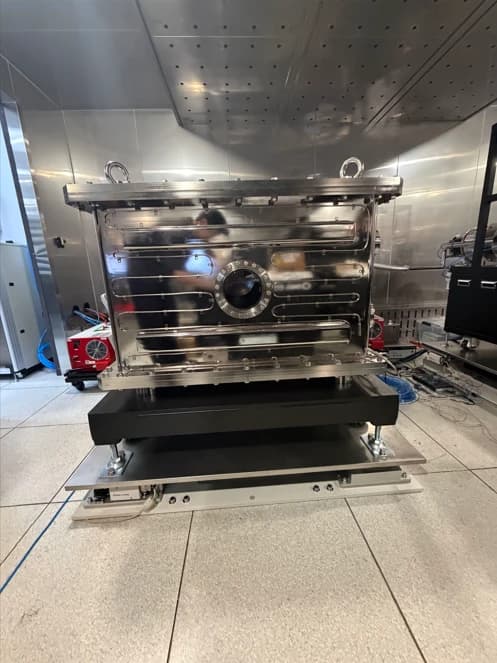
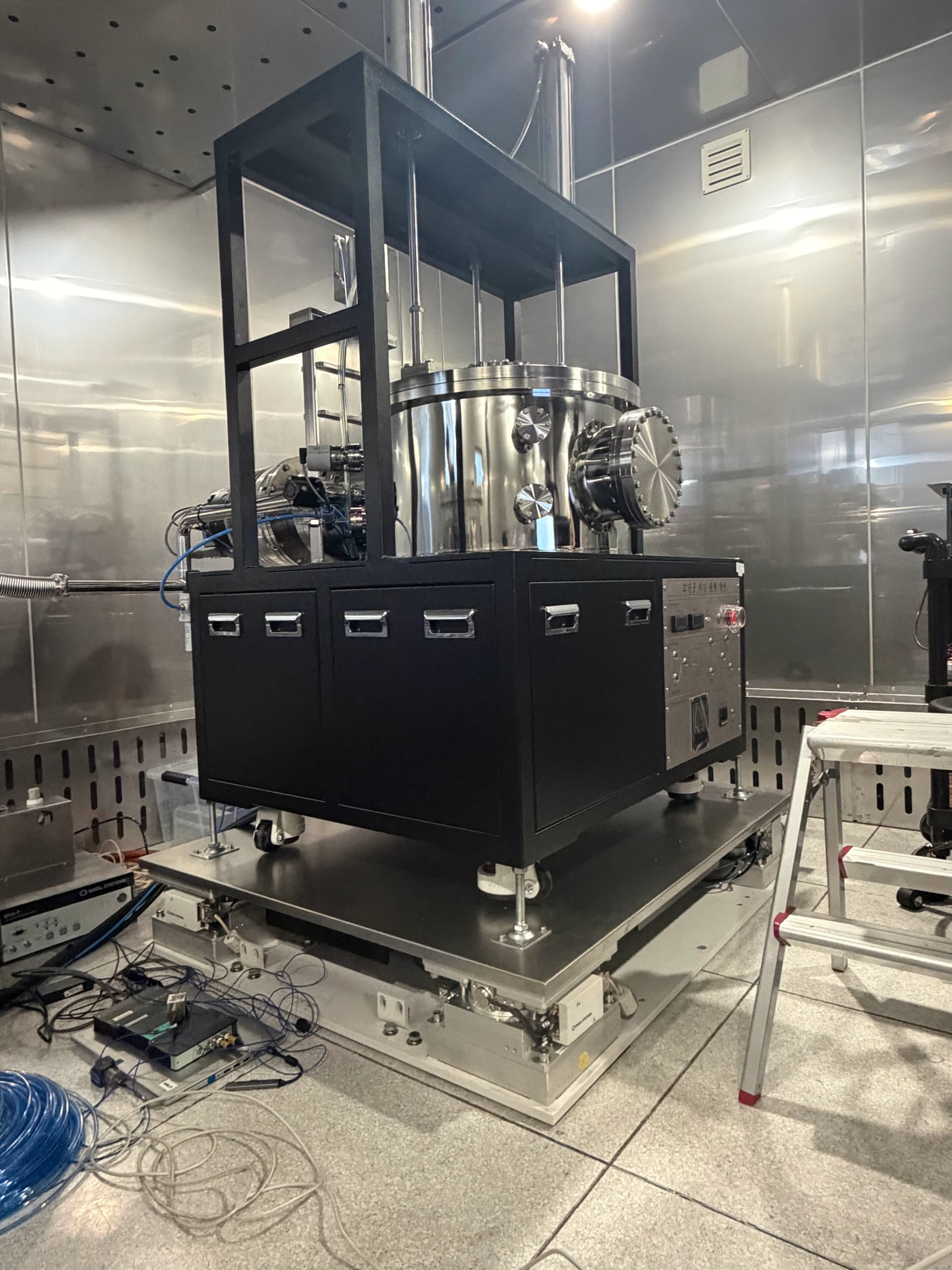
Case Studies
Proven in the field. Installed in the world's most advanced semiconductor, aerospace, and research facilities. Every system measured and verified on-site.Proven in the field. Installed in the world's most advanced semiconductor, aerospace, and research facilities. Every system measured and verified on-site.



Technical Notes
- Vibration Isolation for Semiconductor Metrology and Wafer Inspection
- Cleanroom Vibration Isolation: Access Floors, Settling Time, and Fab-Grade Platforms
- How Active Vibration Cancellation Works: Sensors, DSP, and Actuators
- Feedforward Control: Cancelling Vibration Before It Arrives
- Vibration Isolation for SEM and AFM: Requirements and Solutions
- How to Choose a Vibration Isolation Platform: A Buyer's Guide