KRICT Building 10 L3 EMI room DVIA-MB3000 vibration environment measurement (September 2015)
Contents
Overview
After installing the vibration isolation platform, vibrations were measured to verify that equipment operation would not be affected.
Measurement date and measurement site
Measurement date: 2015. 9. 10 (Thursday), personnel: Sung Won Choi, Daeil Systems
Measurement site: Korea Research Institute of Chemical Technology — Building 10, 3rd floor, electron microscopy laboratory
Measurement conditions and results
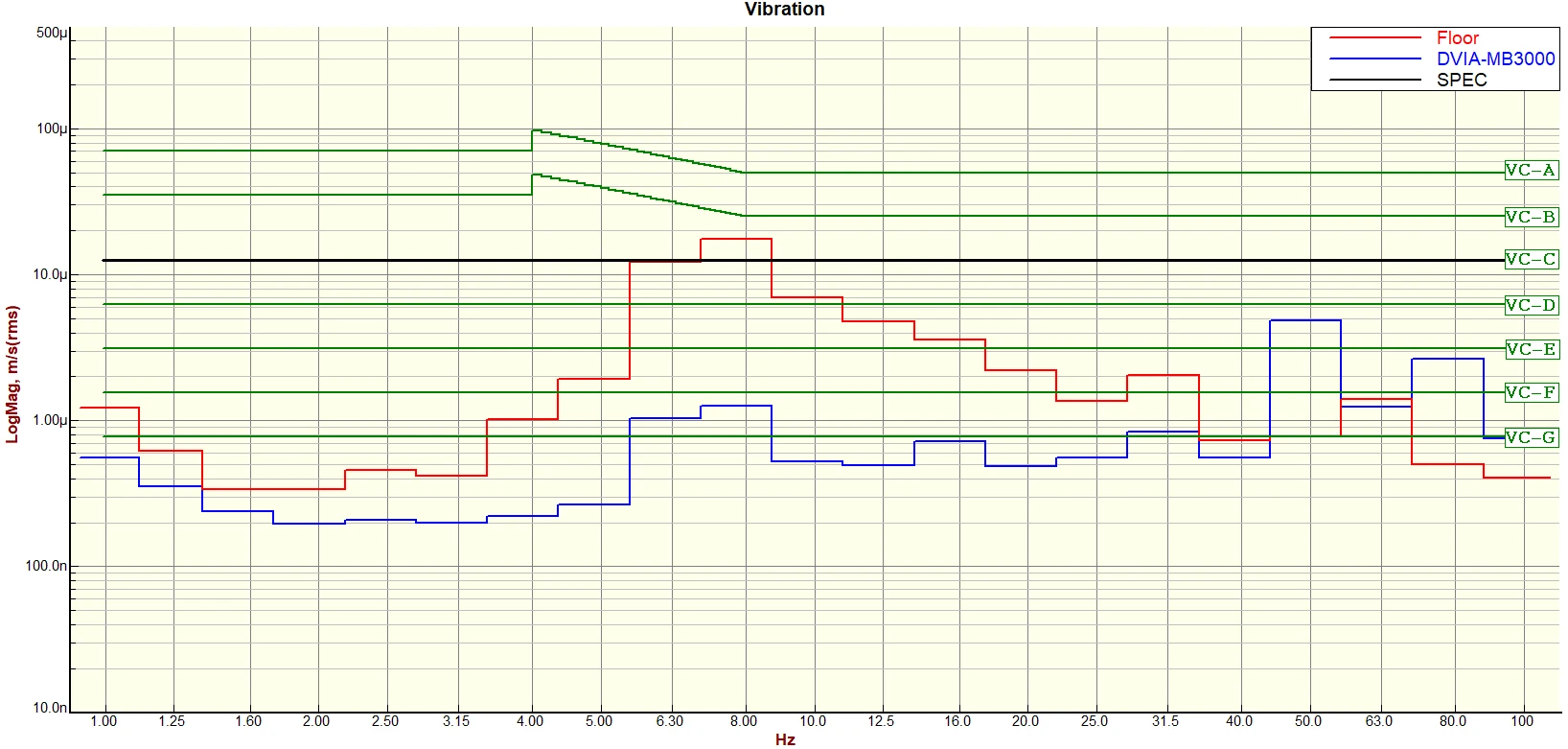
Measurement conditions: The measurement positions are indicated by arrows in the figure below. The top plate of the MB3000 platform and the laboratory floor were measured separately. Results are expressed in VC-CLASS.
Measurement locations (floor BASE and platform TOP)
Summary of measurement results
| Measurement site | Z | X | Y |
|---|---|---|---|
| Floor | C | E | E |
| Isolation top plate | F | F | F |
Horizontal vibration levels across the axes are generally low on the floor. For the vertical axis, floor vibration is favorable below 10 Hz while levels are somewhat higher at and above 10 Hz.
With the vibration isolation applied, vibration levels at the isolation top plate are VC Class F in all measured directions and satisfy the equipment allowable requirement (VC Class E or better).
VC-CLASS vibration environment graphs
Vertical-axis (Z) vibration level
Horizontal-axis (X) vibration level
Horizontal-axis (Y) vibration level
Reference
Generic Vibration Criteria
Notes:
- As measured in one-third octave bands over 8-80 Hz (VC-A/B) or 1-80 Hz (VC-C through VC-G).
- Detail size refers to width in microelectronics fabrication or particle size in medical research.
Share this Case Study
Case Study Information
Related Case Studies
Tier-1 Electronics Component Manufacturer ZEISS Xradia 620 Versa DVIA-MB3000 (201201R2) Installation Report — 2026.02.09
Changping P3 Laboratory Thermo Fisher Scientific Cryo-TEM Krios G4 DVIA-MB3000 (250708R5-1) Installation Report — November 5, 2025
