How to Choose a Vibration Isolation Platform: A Buyer's Guide
Passive or active, table or platform — matching an isolation platform to your instrument, floor, and load, and what to ask a supplier before you sign.
Last updated
1.Start with the Instrument, Not the Catalog
Choosing a vibration isolation platform looks like a product decision, but it is really a diagnosis. The same word — isolation table, anti-vibration table, isolation platform — covers everything from a passive rubber mount under a balance to a six-degree-of-freedom active system carrying a cryo-electron microscope (Cryo-EM), and a catalog cannot tell you which of those you are actually shopping for. What can tell you is the instrument: what resolution it works at, what its manufacturer's floor vibration specification says, and what symptom pushed you to search in the first place — a blurred SEM image, a noisy AFM height trace, an interferogram that will not settle.
This note walks the selection decision in the order that actually determines it: first the site, then the passive-versus-active question, then the instrument type, then load and geometry, and finally the questions to put to a supplier before signing anything. Along the way it points to our deeper notes on each principle rather than repeating them, so that this page stays what it is meant to be — a buying guide, not a physics course.
2.The Site Decides Before You Do
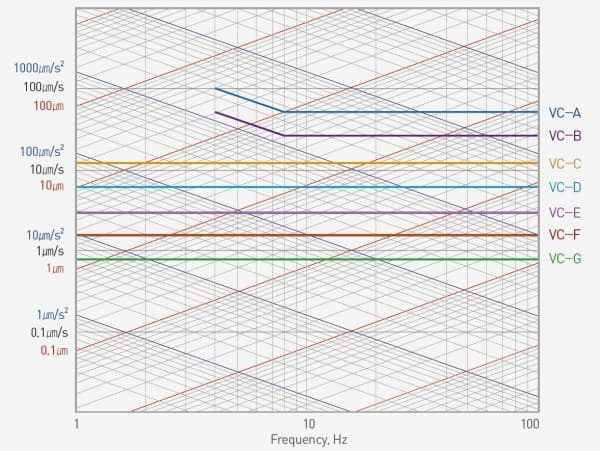
Two identical microscopes can need entirely different isolation because they stand on different floors. A basement slab on grade in a quiet suburb and a seventh-floor bay over a loading dock are different instruments' worth of environment, and no platform specification means anything until you know which one you have. Floor vibration is characterized by where its energy sits in frequency: upper floors of buildings sway at a few hertz and below, rotating machinery and HVAC show up as discrete peaks, foot traffic and carts arrive as transients. Instrument makers state what their tools tolerate using VC (Vibration Criterion) curves — our note on generic vibration criteria explains how to read them — and the honest first step of any selection is measuring what the floor actually does, not assuming it.
This is why a serious supplier offers a site vibration survey before recommending anything. A survey replaces guesswork with a spectrum: it shows whether your problem lives at 30 Hz, where almost any decent platform helps, or at 2 Hz, where most passive supports are at their worst. If a vendor is willing to quote a model number without asking a single question about your floor, that tells you more about the vendor than about the platform.
3.When Passive Is Enough
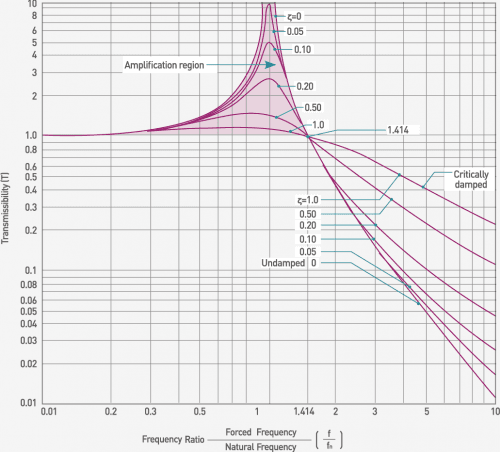
A passive pneumatic isolator is a spring: an air chamber whose natural frequency — typically in the 1.2 to 3.0 Hz range — sets the boundary of what it can do. Above roughly its natural frequency multiplied by the square root of two, it attenuates; well above, it attenuates strongly, which is why passive supports handle vibration from about 5 to 10 Hz upward with ease. Below that boundary they pass vibration through, and near the natural frequency itself they amplify it — a passive isolator on a floor that sways at 2 Hz can make the instrument's world worse, not better. The full mechanics are in our passive isolation note; the selection consequence fits in one sentence: passive is the right answer when the vibration that hurts you lies above the isolator's effective band, and the wrong one when it lies below.
In practice that makes passive platforms the economical choice for a wide middle class of work: optical experiments on ground or basement floors, inspection microscopes, analytical balances, general laboratory instruments whose sensitivity lives above 10 Hz. They need no power, no compressed-air electronics, and little maintenance. An optical table on pneumatic supports remains the standard foundation of laser and photonics labs — and choosing the table itself, its grade, size, and honeycomb construction, is a separate decision we cover in the optical table selection guide.
4.When You Need Active
Active isolation exists because the hardest vibration problems live exactly where passive systems fail: at low frequency. Building sway, ground micro-tremor, and the heavy machinery of an urban site concentrate their energy below 5 Hz, much of it below 2 Hz — inside or below the resonance of any practical passive spring. An active platform closes the gap with sensors and actuators: it measures motion in all six degrees of freedom and drives counter-forces in real time, holding control from 0.5 Hz upward instead of amplifying there. Our notes on active isolation and on how the cancellation loop actually works cover the control engineering; the selection rule is again short. If your instrument resolves nanometers or below — SEM, TEM, Cryo-EM, AFM, semiconductor metrology — or your floor survey shows meaningful energy below about 5 Hz, passive alone will not get you to specification, and active is not an upgrade but the entry ticket.
The numbers make the point concretely. An electron-microscope-class active platform removes up to 80–90% of floor vibration at 1 Hz — a frequency at which a passive isolator is at or near resonance, doing damage rather than good. That inversion, isolation precisely where the passive curve amplifies, is the entire case for the technology, and it is why instrument makers increasingly write sub-hertz floor requirements that only active systems can meet.

5.Matching the Platform to the Instrument
With site and passive-versus-active settled, the field narrows by instrument type, because the platform is not just a filter — it is a piece of the instrument's structure.
For optics and photonics, the decision is a table-and-supports system: a honeycomb optical table for stiffness and damping, on pneumatic supports where floor vibration matters, or rigid supports where it does not. For electron microscopes, geometry drives the format. Some instruments take a platform beneath the whole column, some are best served by a base-type isolator that becomes the microscope's own foundation, and retrofit situations often want modular point-support units slid under an existing frame — low-profile designs go down to about 91 mm tall, which is frequently the difference between isolating an installed microscope and rebuilding the room around it. For semiconductor metrology and wafer inspection, mass is the defining constraint: tools run to many tonnes, and the platform must combine active control with load capacities up to 20,000 kg while settling fast enough for a production line's stage motion. For small benchtop instruments — compact AFMs, interferometers, micro-hardness testers — a tabletop active platform gives sub-hertz-class control in a desktop footprint. And where the problem is bigger than any table, the answer moves into the building itself: an isolated inertial foundation, anchored to the structural slab and mechanically separated from the raised floor, which our DVIF page describes in detail.
6.Load, Motion, and Space: the Unglamorous Constraints
Three practical constraints eliminate more candidate platforms than any performance figure.
First, load — and not just its total. An isolator is sized for a working range; a platform carrying far less than its rating rides too high and stiff, and one near its ceiling has no margin for the accessories that always arrive later. The load's distribution matters as much: a tall microscope column puts its center of gravity high and off-center, and the platform must be planned around where the mass actually sits, which is why suppliers ask for drawings rather than a single number. Second, motion on the payload. A moving stage — a wafer handler, a scanning gantry — injects disturbances the isolation cannot see coming from the floor, and demands damping engineered for fast settling; a platform chosen only for its isolation curve can be embarrassingly slow to quiet down after each move. Third, space and utilities. Height budgets are real — pits, door lintels, ergonomic working heights — and so is the question of what the platform consumes: passive pneumatic systems want clean compressed air or a compressor, while some active systems run entirely without air. None of this is glamorous, and all of it is checkable before purchase from drawings and a serious conversation with the supplier.
7.What to Ask a Supplier Before You Sign
The specification sheet is where supplier conversations start; it should never be where they end. The entries worth checking are few: the natural frequency, which sets where isolation begins; the isolation percentage at a stated low frequency such as 1 Hz; the load capacity and its working range; the settling time, if anything moves on the payload; the installed height; and whether the system needs compressed air. What no sheet can tell you is whether those numbers will hold on your floor — and that is what five questions are for. They separate vendors who will solve your problem from vendors who will ship you a box.
Ask for a site survey — will they measure your floor before recommending, and show you the spectrum? Ask for proof in your application: installation reports for the same instrument model, with before-and-after vibration data, not just a customer logo wall. Ask what acceptance looks like: will they verify performance after installation with measurements against the instrument maker's criterion, and leave you the report? Ask about tuning and service: an active system is a control system, and who retunes it when the payload changes or the building does — and how fast — matters for the decade you will own it. And ask what happens when the standard product does not fit, because with precision instruments it often does not: a supplier who engineers custom platforms around a specific tool is answering a different, better question than one who matches your mass to a table in a price list.
All five questions have the same purpose. They convert the purchase from comparing numbers you cannot independently check into examining evidence you can.
8.Where DAEIL SYSTEMS Stands
We wrote the five questions above because we are comfortable being measured by them. DAEIL SYSTEMS has specialized in vibration isolation since 1984: honeycomb optical tables on pneumatic and rigid supports; passive isolation workstations and mounts; tabletop, platform, base-type, and modular active systems for electron microscopes and AFMs; heavy active-pneumatic platforms for semiconductor metrology; and isolated inertial foundations engineered into the building itself. Site surveys, custom engineering around specific instruments, and post-installation verification are how we work, and more than 1,000 installation case studies — many with before-and-after measurement data — are published openly on this site for exactly the kind of scrutiny this note recommends.
If this guide has done its job, you now know which half of the catalog concerns you. The model-by-model detail — which platform, at which load, for which instrument — is laid out on our active vibration isolation hub and the product pages linked from it; and if you would rather start from the diagnosis than the catalog, a site survey is where we prefer to start too.