How to Choose an Optical Table: Grade, Size, and Supports
Honeycomb structure, table grades, breadboard trade-offs, pneumatic vs. rigid supports, and sizing rules — a practical buying guide for optical tables.
Last updated
1.Why Does a Honeycomb Table Beat a Granite Slab?
Strip away the accessories and an optical table has one job: hold every mirror, lens, and detector in the same relative position while the world vibrates around them. Intuition says the answer is mass — a thick slab of granite feels immovable. But what actually keeps a beam path aligned is not weight; it is the ratio of stiffness to mass, together with damping. A structure with a high stiffness-to-mass ratio pushes its bending resonances far above the frequencies where floors and machinery put in energy, and damping decides how quickly any ringing that does get excited dies away. Solid stone earns its stiffness through sheer mass, and mass alone provides almost no damping — struck once, a stone slab rings.
A honeycomb sandwich attacks the problem structurally instead. In the DVIO optical tabletop, corrugated steel foil just 0.25 mm thick is formed into a honeycomb core and epoxy-bonded vertically between a 4.0 mm thick 430 series stainless steel top skin and a 4.5 mm steel bottom skin, with 2.0 mm steel side walls backed by highly damped composite wood. The geometry is the point: with a cell size of only 2.9 cm², the core reaches a shear modulus of 19,339 kgf/cm² (275,000 psi) and supports the top skin almost continuously, so the skin cannot flex between cells.
The measured result is a work surface whose first resonance sits at 313 Hz on the Research Grade tabletop, with a static compliance of 35 nm/N — push on it with one newton and it yields by 35 nanometers — while the bonded interfaces and damped side walls provide broadband damping that stone cannot match.
2.What Table Grade Do You Actually Need?
DVIO optical tabletops come in three grades — Research, Scientific, and Non-magnetic — and all three share the same architecture: a steel honeycomb core with 0.25 mm foil and 2.9 cm² cells, surface flatness of ±0.03 mm across the working area, and an M6 × 1.0 mounting grid on a 25 mm pitch. What changes between grades is dynamic performance and material.
The Research Grade is the stiffest build, with a resonant frequency of 313 Hz and a static compliance of 35 nm/N. It is the choice when the beam path is long, when components stand tall — levers that magnify any surface rotation — or when the experiment itself injects energy through pulsed sources, shutters, or translation stages. The Scientific Grade delivers 235 Hz and 84 nm/N: comfortably rigid for most photonics, spectroscopy, and inspection work, and the sensible default when nothing about the setup is extreme.
The Non-magnetic Grade answers a different question. Standard tabletops deliberately use a 430 series ferromagnetic stainless steel top skin so that magnetic bases grip the surface. If that magnetism disturbs your instrument, the Non-magnetic Grade swaps in a 304 non-magnetic stainless steel honeycomb core with 4.0 mm 304 stainless top and bottom skins and 304 plate side walls backed by damped composite wood, while matching the Scientific Grade dynamically at 235 Hz and 84 nm/N.
At ordering time the two questions are asked separately: grade (Research or Scientific) and material (Magnetic or Non-magnetic), so a non-magnetic surface does not force any other compromise.
3.Optical Table or Breadboard: Which One Should You Buy?
The distinction is simpler than catalogs make it look. An optical breadboard is a honeycomb plate — 25, 50, or 100 mm thick — that gives you a flat, stiff, tapped surface wherever you already have somewhere to put it: a lab bench, an enclosure floor, an instrument shelf. An optical table is a full platform, 200 to 400 mm thick, that rides on its own support system and anchors an entire experiment.
DVIO breadboards run from 500 × 400 mm at 14 kg — genuinely portable — up to 2400 × 1200 mm at 351 kg, all with the same steel honeycomb construction, mounting holes individually sealed by spill-proof nylon cups, and surface flatness of ±0.1 mm over a 600 × 600 mm area. Structurally they are serious hardware: a 600 × 600 × 50 mm board resonates at 310 Hz with a compliance of 217 nm/N.
Choose a breadboard when the instrument already lives on a bench and only needs a locally rigid, flat reference; when the setup must move between rooms; or when you are building a compact sub-assembly that will later transfer onto a larger table. Choose a table when the beam path spans meters or when the experiment needs floor-vibration isolation underneath it. And note what a breadboard does not do: it has no isolation of its own. It stiffens and flattens whatever it sits on; it does not stop the floor. For isolation, pair it with a support system or place it on an isolation platform.
4.Pneumatic or Rigid Supports: When Does Each Make Sense?
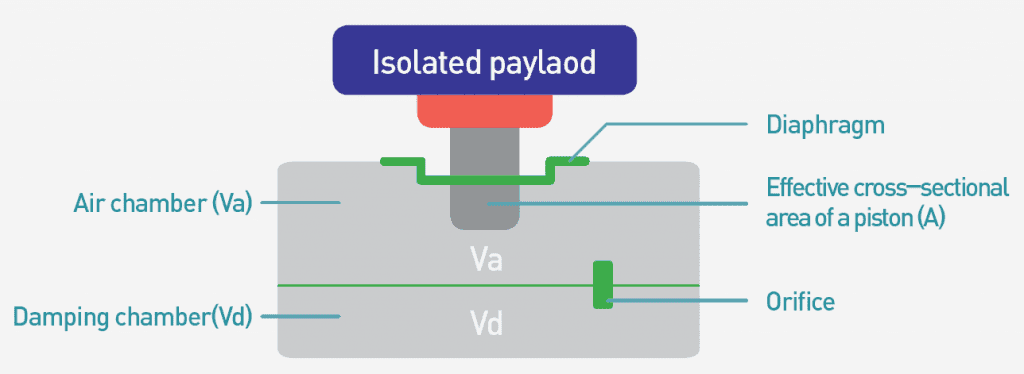
A tabletop only isolates as well as what holds it up. DVIO-S pneumatic supports carry the table on air. Inside each isolator are two chambers. The air chamber, sealed by a rolling diaphragm, supports the load through an internal piston — and it is kept deliberately small, because a smaller air volume gives the isolator a lower natural frequency. The second, damping chamber connects to it through an orifice: as the table moves, air forced through the orifice dissipates vibration energy, damping the system without any mechanical damper linking floor to payload.
The measured behavior: a resonant frequency of 1.2–1.7 Hz and 80–99% vibration isolation at 10 Hz, with load capacities from 100 to 3000 kg. Three two-way leveling valves re-level the table automatically as loads shift, with repeatability of ±1.0 mm on standard valves and ±0.05 mm on precision valves, plus ±20 mm of height adjustment. The cost of this performance is infrastructure: clean dry air at 4–6 bar. Both self-standing legs and tie-bar frames with casters are available; the tie-bar version rolls for repositioning.
Rigid supports are the same formats without the air, and they make sense in three situations: the floor is already quiet and the work is not vibration-critical; no compressed-air line is available or wanted; or the experiment applies forces to the table — heavy moving stages, frequent manual work — that would rock a softly sprung platform. The honest rule: rigid supports position a table; pneumatic supports isolate it.
5.How Big and How Thick Should Your Table Be?
Size the surface first. DVIO optical tabletops are made to order with widths from 1000 to 3600 mm, depths from 600 to 1500 mm, and thicknesses of 200, 300, or 400 mm. Lay the experiment out on paper — every mount, stage, and enclosure, plus working room around them — and keep the mounting grid in mind: M6 holes on a 25 mm pitch, with a 37.5 mm border before the first row of holes at each edge. Each hole carries a 21 mm deep sealing cap, so spilled liquids never reach the core.
Thickness buys stiffness. A tabletop is a plate supported at discrete points, and its resistance to sagging and bending falls rapidly as the span grows — so the longer the table, the thicker the section should be. A 200 mm build suits compact tables; spans approaching the 3600 mm maximum call for 300 or 400 mm. If a single surface still is not enough, joined optical tables combine sections into one continuous surface.
Then match the supports to the total load. The selection rule is simple: first identify the weight of the equipment that will sit on the table — in practice, the total load including the tabletop itself — and only then select the isolator specification. Tie-bar configurations pair table sizes with isolator sizes from ISO-S (300 kg) through ISO-M (500 kg) and ISO-L (1000–1500 kg) to ISO-P (2000 kg), on four or six isolators, while self-standing pneumatic supports reach 3000 kg per set. An undersized isolator operates outside its design load and gives up performance; a grossly oversized one simply wastes budget.
6.When Is a Passive Optical Table Not Enough?
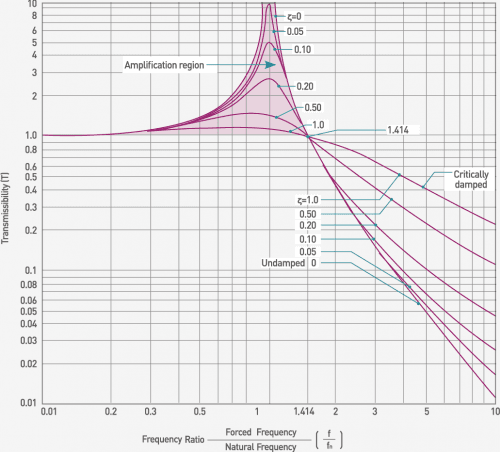
Every passive stack has a floor — literally. The pneumatic supports under a DVIO table resonate at 1.2–1.7 Hz. Around that frequency they amplify floor motion rather than reduce it, and meaningful attenuation develops only well above the resonance, maturing to the 80–99% figure by 10 Hz. That leaves the band below a few hertz — building sway, wind response, heavy traffic — essentially untreated. This is physics, not a defect, and no passive support can escape it: softening the spring lowers the resonance but deepens the amplification problem.
For most optics work the untreated band does not matter; a laser table on a quiet ground-floor slab is served perfectly well by a passive stack. But instruments that resolve nanometers read the low band directly, and the vibration criterion curves make the threshold concrete: SEM, TEM, and e-beam systems specify VC-D, and e-beam lithography VC-E. When a floor survey shows those targets violated below 5 Hz — the band where building sway and heavy traffic concentrate — no passive table can close the gap.
That is where active vibration isolation takes over: sensor, DSP, and actuator loops that cancel vibration from 0.5 Hz in all six degrees of freedom, with no resonant amplification to pay for. For benchtop instruments the crossover product is the DVIA-T, a tabletop active system that begins isolating at 0.5 Hz, requires no compressed air at all, and installs plug-and-play under desktop microscopes and nanoscale metrology tools. The buying rule stays honest in both directions: a quiet floor and an optics experiment want a DVIO passive stack; a sub-5 Hz deficit or a VC-D/VC-E requirement wants active control.