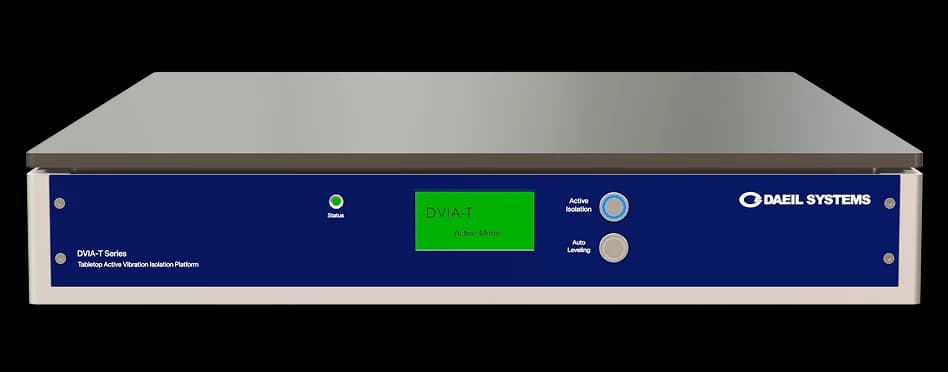
Tabletop Platform
DVIA-T
Nanoscale precision on any desk. 80–90% isolation at 1 Hz.
Tabletop Microscopy
Active vibration isolation cancels vibration in real time: sensors measure motion, a digital signal processor computes a control force, and actuators apply it — suppressing even the low-frequency vibration that passive isolators struggle to reduce. The DAEIL SYSTEMS DVIA active series applies this closed-loop control in all six degrees of freedom, translational and rotational, actively controlling vibration from as low as 0.5 Hz. It helps electron microscopes, AFMs, and semiconductor metrology tools meet their vibration criteria and deliver their intended performance, even at demanding sites. Built by a vibration isolation specialist since 1984.
Tabletop Platform
Nanoscale precision on any desk. 80–90% isolation at 1 Hz.
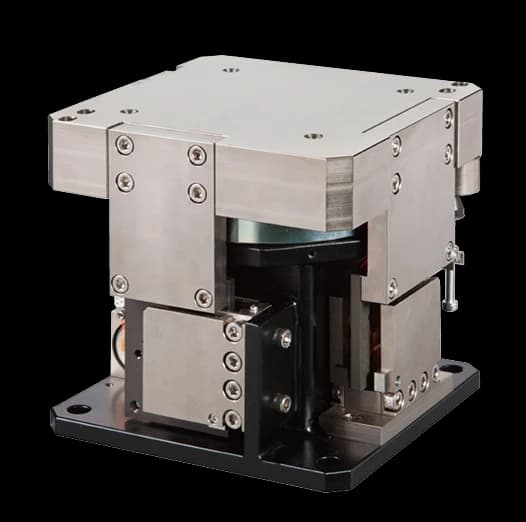
OEM Isolation Module
Seamlessly embedded. Instruments that refuse to shake.
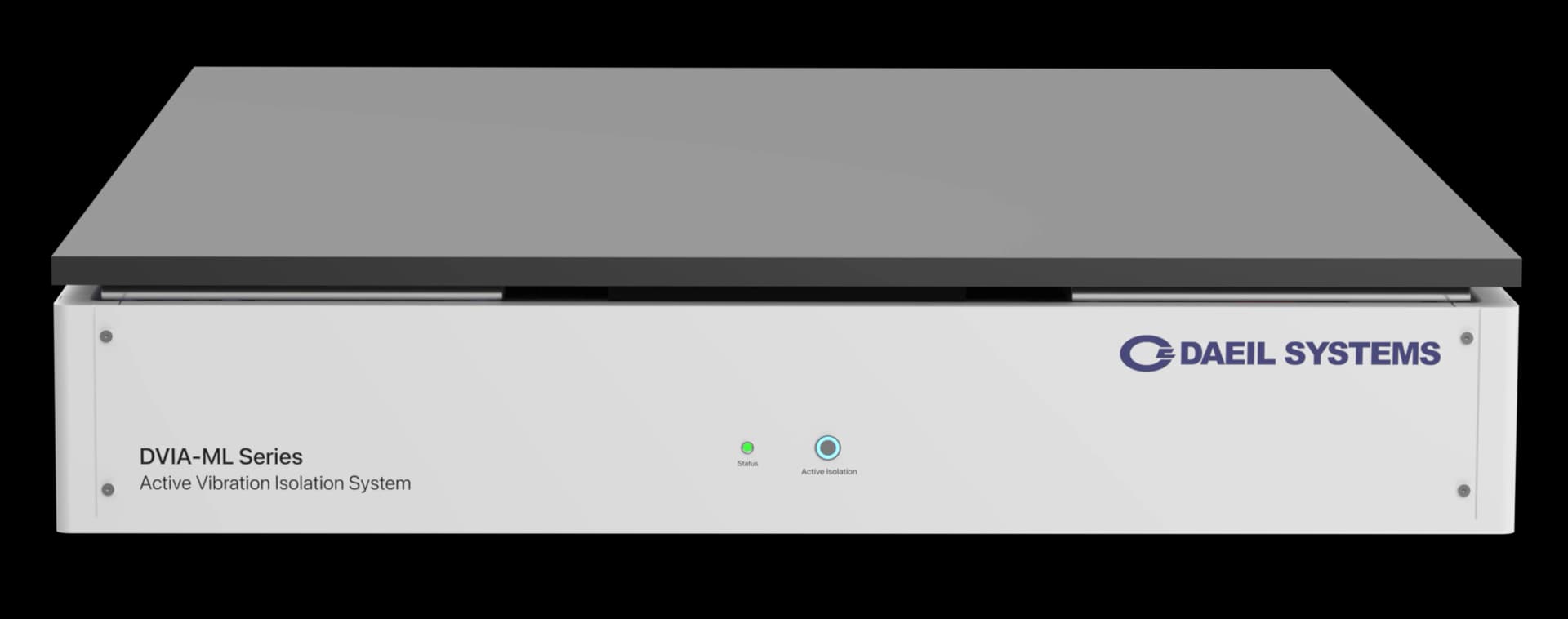
custom active platform
Active control from 0.5 Hz. Multi-axis. Uncompromising.
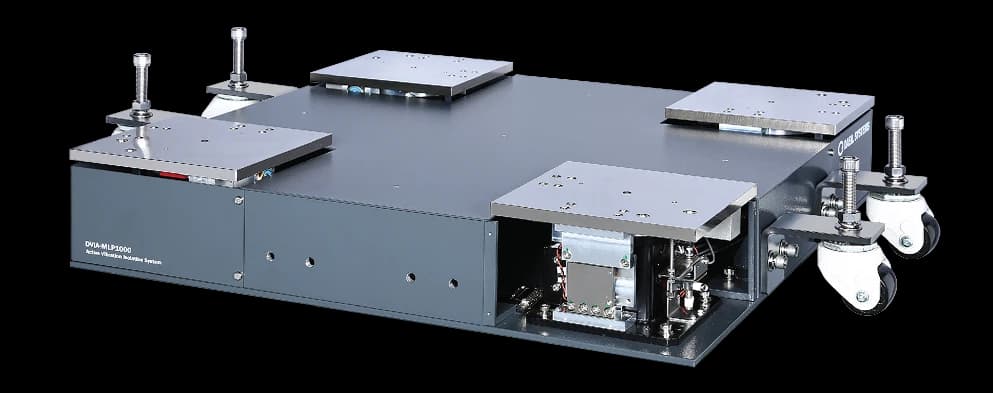
Custom active platform for Thermo Fisher
Large-scale stability. Engineered for the most demanding payloads.
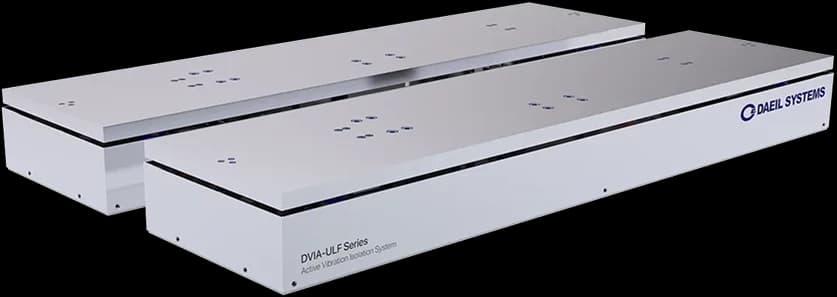
modular active isolator
70–90% isolation at 1 Hz. Slides in at just 91 mm.
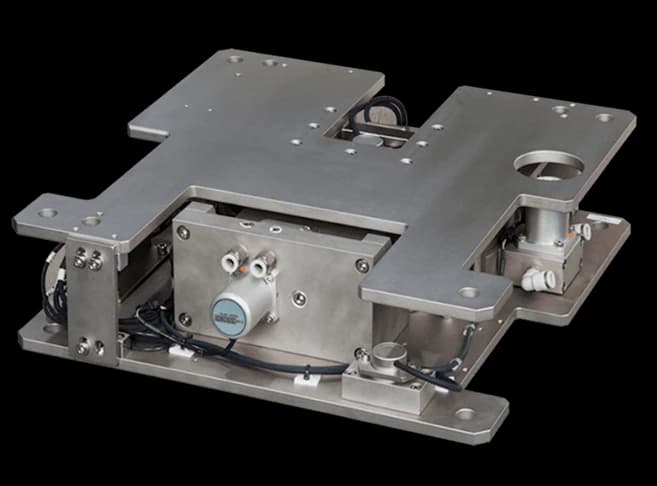
active isolation system for semiconductor
Purpose-built for semiconductor metrology. Clean-room ready.
Active vibration isolation is closed-loop vibration cancellation: instead of absorbing floor motion with springs or air, an active system measures vibration directly and generates an equal and opposite force to remove it. Every active vibration isolation system combines three elements — sensors to measure motion, a controller to compute the response, and actuators to apply it.
DVIA systems run two control paths at once. On DVIA's electromagnetic platforms, the feedback loop uses geophone velocity sensors (sensitivity 2.55 V/in/s, approximately 100.4 V/m/s) mounted on the isolated platform to measure residual vibration — the motion that actually reaches your instrument. A digital signal processor computes the required counter-force, and electromagnetic actuators apply it in real time, with response under 0.5 ms on some models. The clean-room DVIA-P implements the same principle with accelerometers and pneumatic servo actuators. Feedforward control works ahead of the payload: floor-mounted sensors detect incoming ground vibration, and the controller cancels it before it propagates into the platform.
Feedback control operates in all six degrees of freedom — three translations (X, Y, Z) and three rotations (θx, θy, θz) — suppressing platform motion whichever path floor vibration takes. Feedforward control, which measures floor vibration directly, works alongside it on the three translational axes. The active control bandwidth runs from as low as 0.5 Hz up to 200 Hz, depending on model (measured).
The difference between active and passive vibration isolation shows up at low frequency. A passive pneumatic isolator is a spring, typically with a natural frequency of 1.2–3.0 Hz. Near that natural frequency it amplifies vibration, and sufficient isolation appears only at frequencies several times higher. In an active system, the control loop actively damps the resonant peak, so there is no such amplification band, and vibration control starts as low as 0.5 Hz.
| Aspect | Active vibration isolation | Passive isolation (pneumatic) |
|---|---|---|
| Effective band | Active control from 0.5 Hz — working below the natural frequency of typical pneumatic isolators (1.2–3.0 Hz) | Isolation begins at about √2 times the natural frequency, with sufficient isolation only several times higher; the band below is transmitted or amplified |
| Isolation at 1 Hz | 80–90% reduction of floor vibration; 90% or more at 2 Hz and above (DVIA-ML, measured vertically and horizontally) | No isolation — close to the 1.2–3.0 Hz resonance, vibration is transmitted or amplified |
| Resonance amplification | The control loop actively damps the resonant peak — no amplification peak within the measured band (1–100 Hz) | Transmissibility rises above unity near the natural frequency, so the platform moves more than the floor |
| Response to disturbance | The control loop responds in real time, so residual vibration settles quickly | Damping is limited, so after a disturbance the platform keeps oscillating at its natural frequency for some time |
| Axes of control | Feedback control in all six degrees of freedom — X, Y, Z, θx, θy, θz | No control loop; behavior fixed by spring stiffness and damping |
| Ground vibration handling | Feedforward from floor sensors compensates incoming vibration in advance | Does not sense floor vibration; isolates only as much as the spring filters out |
DVIA active systems control vibration from as low as 0.5 Hz. At 1 Hz, where a passive pneumatic isolator provides no isolation, the DVIA-ML reduces floor vibration by 80–90%, and by 90% or more at 2 Hz and above (measured vertically and horizontally).
Performance is read from the transmissibility curve, which shows how much the platform moves relative to the floor at each frequency. A passive isolator's curve rises above unity near its natural frequency (1.2–3.0 Hz): the platform moves more than the floor. On the DVIA, the control loop actively damps the resonant peak, so no such amplification peak appears within the measured band (1–100 Hz).
The low end matters most. Building sway and low-frequency floor vibration lie at a few hertz and below — the band that passive isolators amplify or pass straight through. At an actual installation, performance is evaluated by applying the transmissibility to the floor vibration and comparing the resulting platform vibration with the VC (vibration criterion) curves used in electron microscope and metrology instrument specifications.
Active vibration isolation is built for instruments that resolve nanometers on floors that move. Electron microscopes — SEM, TEM, and cryo-EM — are the defining case: the column acts as a lever, turning small platform rotations at 1–3 Hz into image blur at the sample. The DVIA-ML controls their vibration from 0.5 Hz, carries payloads up to 6,000 kg (ML6000), and is designed to emit less than 0.05 μT of magnetic field — safe for electron optics. DVIA-MLP applies the same engineering to Thermo Fisher SEMs.
AFM and SPM are just as exposed: floor vibration appears directly in the sub-nanometer height signal. DVIA-ULF and the tabletop DVIA-T keep them still. In the fab, the clean-room-ready DVIA-P brings active isolation to CD-SEM, DR-SEM, and photomask inspection, where measurement repeatability depends on a stable stage. E-beam lithography, X-ray metrology, and NMR complete the set — each limited by low-frequency vibration that a passive 1.2–3.0 Hz pneumatic mount cannot remove. For instrument makers, the DVIA-M OEM module embeds active isolation inside the tool itself.
DVIA is the active vibration isolation product series of DAEIL SYSTEMS, a Korean manufacturer of precision vibration isolation equipment since 1984. The series covers six model lines: DVIA-T tabletop platforms for desktop microscopy, DVIA-M OEM modules for embedded integration, DVIA-ML custom platforms for SEM, TEM and e-beam systems, DVIA-MLP platforms for Thermo Fisher SEM, DVIA-ULF ultra-low-frequency modular isolators for SEM, TEM and AFM, and DVIA-P systems for semiconductor metrology tools.
An active vibration isolation system cancels vibration with a closed control loop instead of a passive spring. Sensors measure vibration, a digital signal processor computes an equal-and-opposite counter-force, and actuators apply it in real time. The DAEIL SYSTEMS DVIA series controls all six degrees of freedom, actively damps the resonant peak, and controls vibration from as low as 0.5 Hz, with active bandwidth up to 200 Hz depending on model.
Two kinds of control run in parallel. Feedback: sensors on the isolated platform measure residual vibration, and a DSP drives the actuators to cancel it, with response under 0.5 ms on some models. Feedforward: sensors on the floor detect incoming ground vibration and cancel it before it reaches the payload. DVIA systems apply feedback control in all six degrees of freedom and feedforward control on the three translational axes.
A passive pneumatic isolator is a spring, typically with a natural frequency of 1.2–3.0 Hz. It amplifies vibration near that natural frequency, and sufficient isolation appears only at frequencies several times higher. An active system measures vibration and counteracts it: control starts as low as 0.5 Hz, the reduction reaches 80–90% at 1 Hz (DVIA-ML, measured vertically and horizontally), and the control loop actively damps the resonant peak, so there is no amplification peak within the measured band (1–100 Hz). Active isolation is strongest exactly where passive mounts perform worst.
When the vibration limiting your instrument sits in the low-frequency band that a passive isolator cannot isolate — a few hertz and below. Building motion concentrates energy at low frequency, where passive pneumatic isolators amplify vibration or pass it straight through. If a site survey shows peaks in the 1–3 Hz band, or an electron microscope or AFM still shows vibration-induced blur on a passive table, active isolation targets that band directly — and is the practical route to strict VC-class siting requirements.
The active control bandwidth of DVIA systems runs from as low as 0.5 Hz up to 200 Hz, depending on model (measured). The DVIA-ML reduces floor vibration by 80–90% at 1 Hz and by 90% or more at 2 Hz and above (measured vertically and horizontally). This covers the low-frequency band where passive pneumatic isolators either amplify vibration or barely attenuate it — the band that matters most for electron microscopes and nanoscale metrology.
Instruments resolving nanometer or sub-nanometer features: SEM, TEM and cryo-EM, AFM/SPM, e-beam lithography, X-ray metrology, NMR, and semiconductor wafer metrology and inspection (CD-SEM, DR-SEM, photomask inspection). The DVIA lineup covers each: DVIA-ML for electron microscopes up to 6,000 kg, DVIA-P for the fab, DVIA-T for desktop microscopy, and DVIA-M for OEM integration inside the instrument itself.
Find the vibration isolation system engineered for your application domain.