Hitachi High-Tech TEM HT7830 DVIA-ULFB1000 Installation Report
Contents
Overview
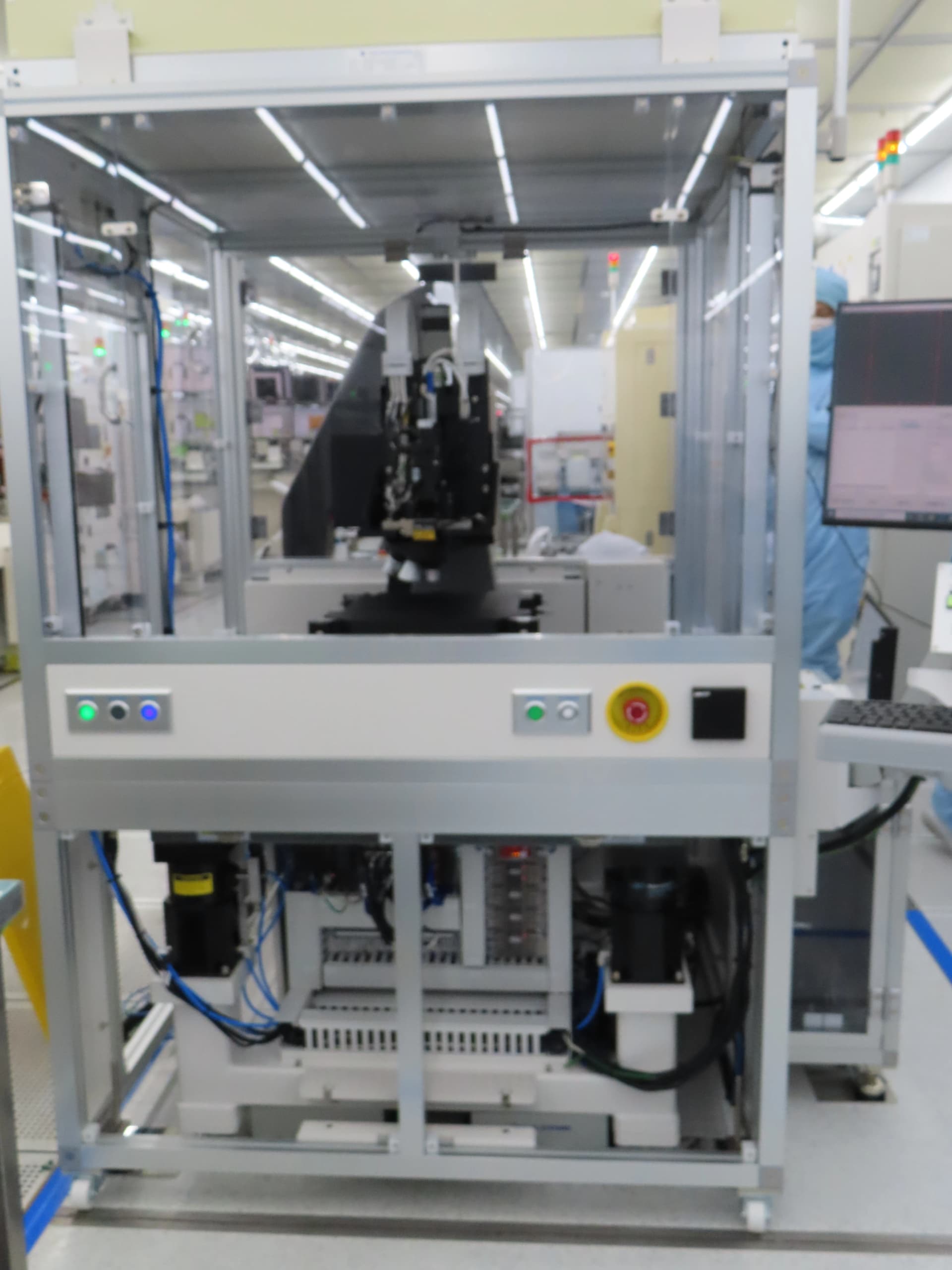
After the installation of the DVIA-ULFB1000 in the 1st-floor laboratory of the Hitachi NCK Center, tuning and vibration measurement were performed.
Inspection and vibration measurement were carried out in the as-is condition.
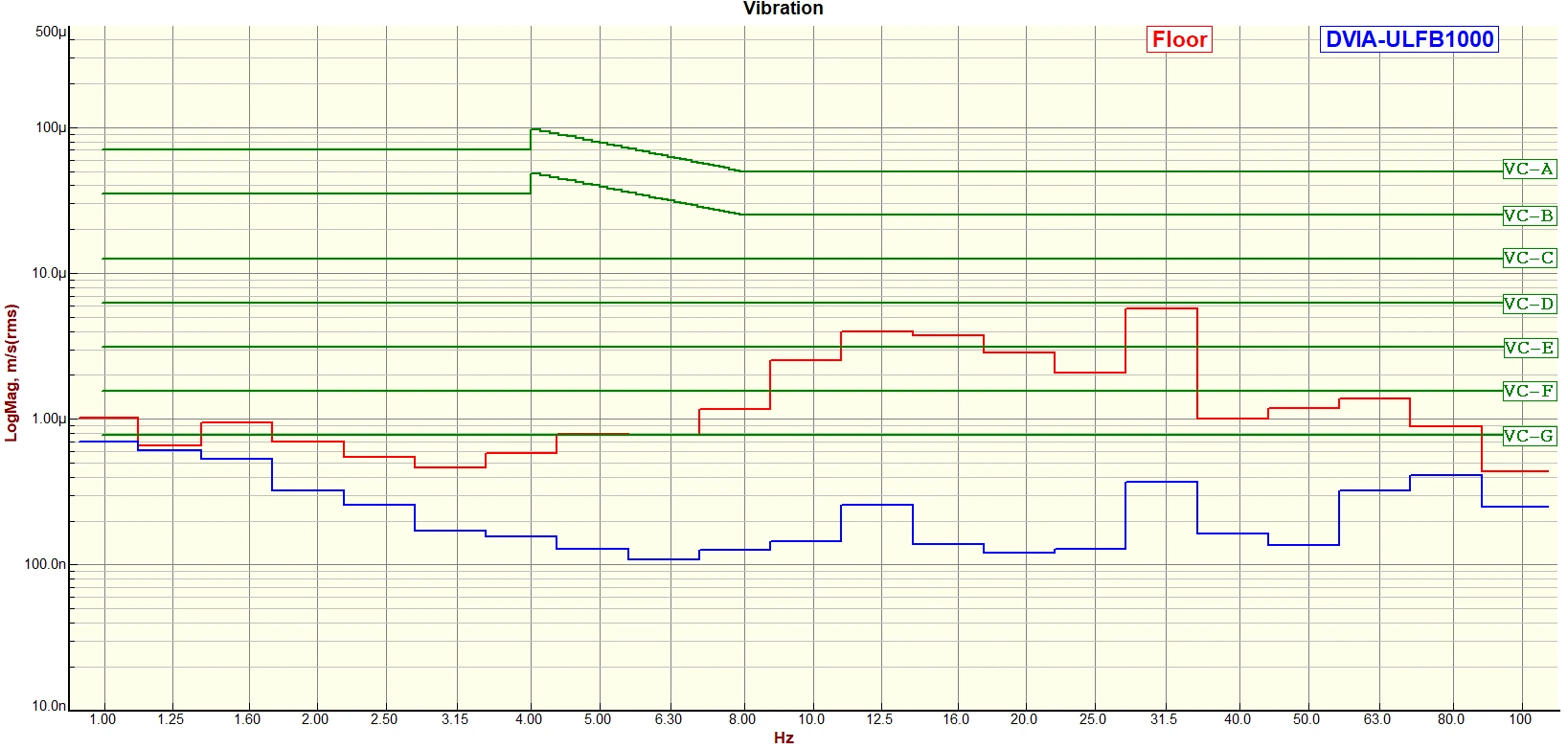
The measurement data are presented in VC Curve format, along with reference material on the vibration levels.
Vibration Isolation System Information
Model: DVIA-ULFB1000
Serial Number: 260611R4
Engineer
Gyumin Park, Changhyun Moon · DAEIL SYSTEMS
Tuning Date
2026.09.23
Installation Site
1st-floor laboratory, Hitachi Suwon NCK Center
End User
Hitachi High-Tech
Customer Equipment
Manufacturer: Hitachi High-Tech
Equipment: TEM
Model: HT7830
Vibration Specification
Horizontal
| Frequency [Hz] | Specification [µm pk-pk] | |
|---|---|---|
| 1 | 2 | |
| 1 | 0.8 | |
| 3 | 0.8 | |
| 3 | 1.5 | |
| 20 | 1.5 | |
| 20 | 2 | |
| 100 | 2 | |
Vertical
| Frequency [Hz] | Specification [µm pk-pk] | |
|---|---|---|
| 1 | 3 | |
| 3 | 3 | |
| 3 | 1.5 | |
| 20 | 1.5 | |
| 20 | 1 | |
| 100 | 1 | |
Equipment Condition
IDLE
Vibration Measurement Equipment
10.1) Measurement Equipment
Hardware: B&K Front End Type 3040-A-040
Software: B&K Pulse Labshop22 Version
10.2) Accelerometer
PCB 393B05
Vibration Measurement Setup
F Span: 200 Hz
Lines: 2400
Engineering Units: m/s
Window: Hanning
Averaging: FFT Spectrum Averaging
Conclusion
To secure a stable operating environment for the Hitachi High-Tech TEM (HT7830) installed in the 1st-floor laboratory of the Hitachi NCK Center, the installation and tuning of the DVIA-ULFB1000 (S/N 260611R4) vibration isolation platform were carried out. The measurement results confirmed that the inherent floor vibration at the installation location was already at the VC-E level on the vertical (Z-axis) and the VC-G level on the horizontal (X/Y-axis), a very excellent low-vibration environment. Accordingly, this tuning was focused on securing long-term operational stability rather than pursuing aggressive vibration reduction performance, and as a result it was confirmed that the equipment's required vibration specification (Section 8) is stably satisfied on all axes (Z, X, Y). This confirms that the current installation location provides a very suitable vibration environment for the operation of the TEM (HT7830), and stable equipment operation is expected to continue in the future.
Measurement Data Summary
| Measurement Point | Vibration Specification | Measurement Axis | Measurement Result | |
|---|---|---|---|---|
| Floor | DVIA-ULFB1000 | |||
| 1. Floor 2. DVIA-ULFB1000 | See Section 8 | Vertical (Z-axis) | ✓ PASS | ✓ PASS |
| Left to Right (X-axis) | ✓ PASS | ✓ PASS | ||
| Front to Back (Y-axis) | ✓ PASS | ✓ PASS | ||
Measurement Data
Z-axis — Autospectrum
X-axis — Autospectrum
Y-axis — Autospectrum
Installation Photo
Reference
The table below classifies vibration levels based on IEST-RP-CC012.2.
Notes:
1. As measured in one-third octave bands of frequency over the frequency 8 to 80 Hz (VC-A and VC-B) or 1 to 80 Hz (VC-C through VC-G).
2. The detail size refers to the width in the case of microelectronics fabrication, the particle (cell) size in the case of medical and pharmaceutical research, etc. It is to imaging associated with probe technologies, AFMs, and nanotechnology.
The information in this table is provided for reference. In most cases it is advisable to seek the advice of a specialist familiar with the application and the vibration requirements of the equipment and process.