Vibration Isolators: Types, How They Work, and How to Choose
What vibration isolators are, how transmissibility governs every type, where elastomer, spring, and pneumatic mounts fit, and how to choose from a floor survey.
Last updated
1.What Is a Vibration Isolator?
A vibration isolator is a compliant element or device that decouples an object from a vibrating support — either shielding a sensitive payload from a moving floor, or preventing a vibrating machine from shaking everything around it. In its simplest form it is nothing more than a soft connection deliberately placed between two structures: a rubber pad under a pump, a set of springs beneath an air handler, an air-filled mount under a laboratory bench. In its most advanced form it is a sensor-driven platform beneath an electron microscope that measures motion and cancels it in real time. Every version, from the humblest pad to the fastest control loop, exists to solve the same problem — vibration travels through rigid connections, and inserting compliance interrupts the path.
The word carries some ambiguity worth clearing up first. Engineers also speak of RF and microwave isolators, which pass electromagnetic signals in one direction only; optical isolators, which do the same for light; and seismic base isolators, which protect entire buildings from earthquakes. This note concerns none of those. It covers mechanical vibration isolators — the springs, mounts, and platforms that protect precision equipment and machinery from everyday floor and machine vibration.
One distinction organizes the entire field: which side of the vibration you are on. Source isolation places the isolator under the thing that vibrates — a compressor, a stamping press — so its disturbance does not propagate into the building. Receiver isolation places the isolator under the thing that must stay still — a microscope, an interferometer, a metrology tool — so the building's motion does not reach it. The physics is identical in both directions; only the design targets differ. The sections that follow build from that shared physics toward the receiver-isolation problem, which is where precision instruments live and where the choice of isolator is most consequential.
2.How an Isolator Works: The Mass-Spring-Damper
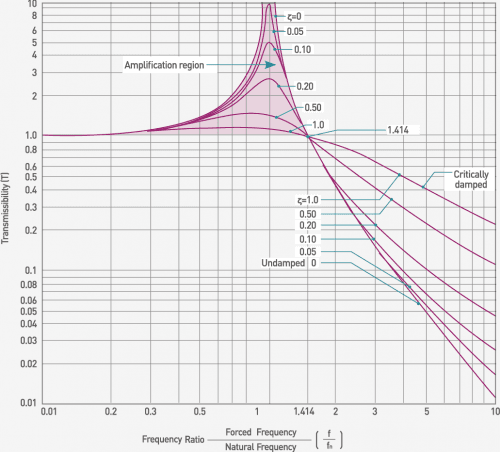
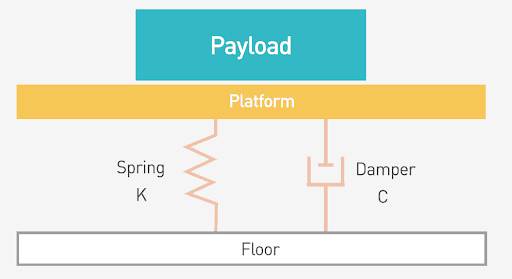
Strip away construction details and every mechanical isolator reduces to the same model: a payload mass resting on a spring, with some damping in parallel. That pairing has a natural frequency — the rate at which the mass oscillates when disturbed — set by the mass and the spring stiffness. How the isolator treats incoming vibration depends entirely on where that vibration's frequency sits relative to the natural frequency, and the relationship is captured in a single curve called transmissibility: the ratio of the motion that reaches the payload to the motion of the floor, plotted against frequency.
The curve has three regions. Well below the natural frequency the payload simply follows the floor, and transmissibility is essentially 1 — the isolator does nothing. Near the natural frequency the spring stores and returns energy in step with the payload's own oscillation, and transmissibility rises above 1: the isolator amplifies. Only above roughly 1.414 times the natural frequency — the square root of two — does transmissibility fall below 1 and genuine isolation begin, improving steadily as frequency rises. Our companion note on passive isolation systems derives the transmissibility function in full.
The curve also explains the central design tension. A softer spring lowers the natural frequency, moving the onset of isolation down and widening the protected band — which is why precision isolators pursue low natural frequencies so aggressively. But softness has costs: the payload sags more under load, sways more when touched, and takes longer to settle after any disturbance. Every isolator type in the next section is, at heart, a different engineering answer to the question of how soft a support can practically be made.
3.A Tour of Passive Isolator Types
Elastomer and rubber mounts are the entry point: blocks or bushings of engineered rubber that combine spring and damper in one molded part. Their natural frequencies are comparatively high — typically in the tens of hertz — so they suit machinery isolation and structure-borne noise control rather than precision work: pumps, fans, compressors, engine mounts. Metal coil springs reach lower, into the single-digit hertz range, and carry heavy loads indefinitely without creep, which makes them the standard under HVAC plant and industrial equipment; their weakness is minimal internal damping, usually remedied by pairing them with elastomer elements.
Wire-rope isolators — loops of stranded steel cable clamped between bars — earn their place in shock and transport applications: the friction between strands provides damping no environment can degrade, and they perform in any orientation and across an unusually wide temperature range. For precision laboratories, however, the workhorse is the pneumatic isolator, which supports the payload on a volume of pressurized air. Air columns make remarkably soft springs, achieving natural frequencies of 1.2 to 3.0 Hz, and because load is carried by pressure rather than deflection, capacity can be adjusted by regulating pressure while automatic leveling valves hold the platform at constant height.
At the exotic end sit negative-stiffness mechanisms, which use buckled beams or opposed springs to cancel part of a conventional spring's stiffness, pushing natural frequencies below 1 Hz without power; they are genuinely effective but sensitive to load changes and tuning drift. The selection logic across all these types is consistent: match load capacity to the payload, and set the natural frequency well below the lowest disturbance frequency you need attenuated — isolation only begins above 1.414 times the natural frequency, and meaningful attenuation needs more margin than that. That last requirement is where every passive type, even the best pneumatic mount, meets a wall.
4.The Low-Frequency Wall
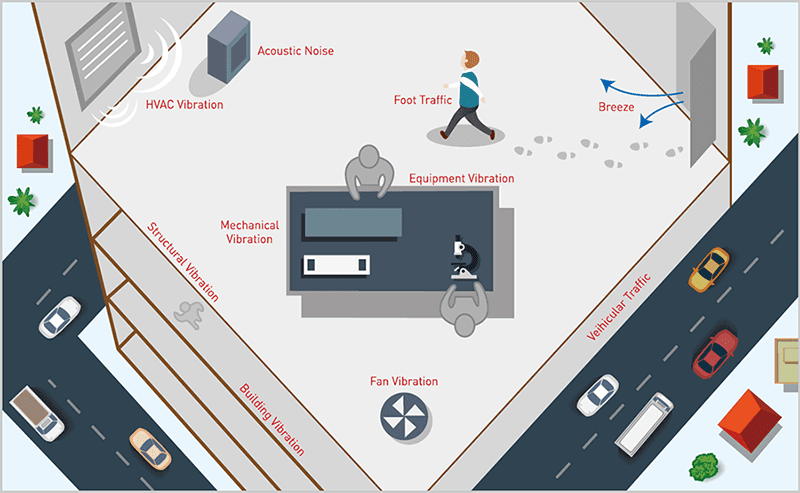
Recall the shape of the transmissibility curve: every passive isolator amplifies at its own resonance and begins isolating only above 1.414 times its natural frequency. For the best conventional passive technology — pneumatic mounts at 1.2 to 3.0 Hz — that places the amplification band between roughly 1 and 4 Hz and useful isolation only above roughly 5 to 10 Hz. Now look at what a building actually does. Floor vibration energy concentrates below about 20 Hz, and much of it below 5 Hz: foot traffic, HVAC machinery, road traffic, and the slow sway of the structure itself. The passive isolator is weakest precisely where the building moves most.
There is no escape from this geometry within conventional passive technology — elastomer, spring, or pneumatic. Softening the spring to lower the natural frequency deepens sag and sway and merely relocates the resonance to a band that building motion still excites; adding damping to tame the resonance peak degrades the high-frequency roll-off that was the isolator's reason for existing. Our companion note on active versus passive isolation works through this damping trade-off quantitatively. The conclusion it reaches is structural, not incremental: for disturbances below roughly 5 Hz, conventional passive isolation cannot be tuned into adequacy (negative-stiffness designs reach lower, but their load-change and drift sensitivity keeps them niche).
Active isolators change the mechanism instead of the tuning. Sensors measure the vibration, a digital controller computes a counter-force, and actuators apply it — cancelling motion rather than filtering it through a spring, with control effective from 0.5 Hz and the resonance peak suppressed electronically rather than by a mechanical damper. Our companion note on how active vibration cancellation works follows that signal chain — sensing, computation, actuation, and the stability limits that govern it — in detail. For the purpose of choosing an isolator, the operational summary is enough: active vibration isolation is the only isolator class that removes energy in the band where buildings move most.
5.Choosing an Isolator: Survey First, Catalog Second
Isolator selection starts with two questions that cost nothing. First, which side of the vibration are you on? Isolating a source — a chiller, a press — is usually a matter of load capacity and a natural frequency comfortably below the machine's operating speed, and elastomer or spring mounts settle it. Isolating a receiver — a precision instrument — inverts the problem: the disturbance spectrum is now the building's, not the machine's, and it must be measured rather than read off a nameplate. Second, what does the payload weigh, and where is its center of gravity? Capacity and stability requirements eliminate whole categories of isolator before performance is even discussed.
For receiver isolation the decisive step is a floor survey: a seismic-grade sensor at the actual installation spot, measured during the worst realistic operating window, with the resulting velocity spectrum compared band by band against the vibration criterion (VC) curves instrument makers use to specify allowable floor motion — our vibration criteria and electron microscope notes tabulate the classes. If the survey passes everywhere, the floor itself may suffice. If it fails only above 10 Hz, a pneumatic passive system closes the gap. If it fails below 5 Hz, only active control can.
Environmental constraints then filter the remaining candidates. A cleanroom demands materials and actuators compatible with particle and outgassing limits. An electron microscope adds magnetic sensitivity: an isolator whose actuators leak stray field would trade one image artifact for another. Available height, seismic restraint requirements, and compressed-air supply all narrow the field further. The method's virtue is that it is falsifiable at every step — each choice traces back to a measured spectrum and a documented requirement, not to habit or brochure. Our active-versus-passive companion note works the survey-reading logic as an explicit checklist.
6.Where the DAEIL SYSTEMS Lineup Fits
DAEIL SYSTEMS, a vibration isolation specialist since 1984, builds across the whole selection map just described. For the jobs passive physics handles — quiet slabs, disturbance energy above roughly 10 Hz, instruments with moderate VC targets — the passive lines apply: DVIM pneumatic vibration isolation mounts with natural frequencies of 1.2 to 3.0 Hz, DVID passive vibration isolation workstations, and honeycomb optical tables and breadboards for laser and photonics work.
When the survey fails at low frequency, the DVIA active series takes over, with control effective from 0.5 Hz up to 200 Hz depending on model, in all six degrees of freedom. The DVIA-T is the tabletop active isolation system. Modular DVIA-ULF point isolators install as independent units under SEM, TEM, and AFM setups. For electron microscopes the DVIA-ML removes up to 80–90% of floor vibration at 1 Hz and 90% or more from 2 Hz upward while holding magnetic emission below 0.05 μT, on platforms custom-designed for specific instruments — Krios G4, Glacios 2, and JEM-F200 among them — with capacity reaching 6,000 kg on the DVIA-ML6000; the base-type DVIA-MB applies the same six-axis control as the instrument's own base. In cleanrooms, the DVIA-P runs accelerometers and pneumatic servo actuators on the same closed-loop principle for semiconductor inspection tools.
More than 1,000 published installation case studies — spanning SEM, TEM, AFM, and semiconductor metrology — document how consistently the survey-first method converges on the right isolator, whether that turns out to be a passive mount or an active platform. If your own floor data points below 5 Hz, the model-by-model comparison on our active vibration isolation systems hub is the next step.