Hitachi Regulus 8230 DVIA-U350 Installation Report
DVIA-U Series
Installation Report
Hitachi
Contents
Introduction
This report provides the details of the installation of the U350 for the Hitachi Regulus 8230 in 1Q14-01, Building 81, 974 East Arques Avenue, Sunnyvale, CA 94085. Applied Materials hired VEC to install the vibration isolation system and provide a report of the completed work.
Summary
Below is a summary of the results:
U350 ON PASSED the Vibration specifications
Product Details
| Part Delivered | Serial Number | Software |
|---|---|---|
| U350 | 240614R2-4 | - |
Summary of Work
We installed the system by
- Positioning the modular platform under the microscope
We tested the system by
- Creating and uploading a site-specific tune
- Collecting vibration data to verify the performance
We left the system
- In position and turned on
Procedures
Vibration
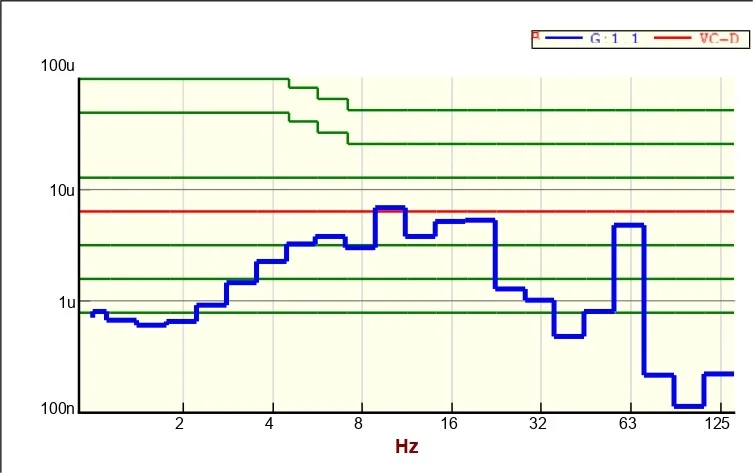
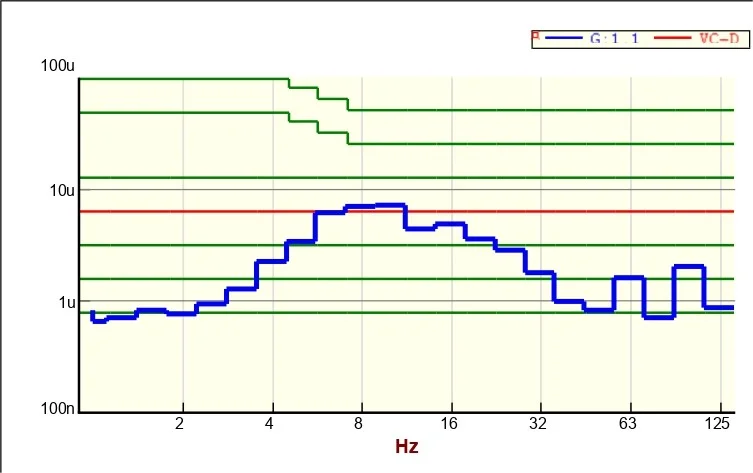
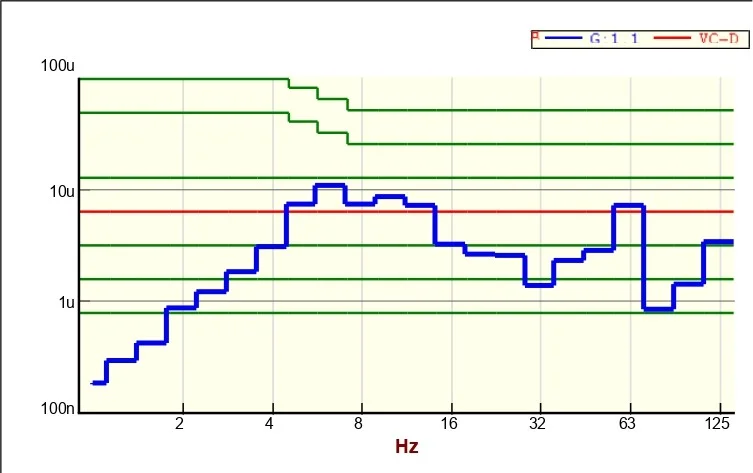
VEC conducted vibration measurements in six directions. Acceleration measurements were taken at a bandwidth of 200Hz with units of um (Pk-Pk). The acceleration spectra with 200Hz bandwidths were recorded.
Setup
| Vibration | |
|---|---|
| Bandwidth | 200Hz |
| Lines | 3200 |
| Window | Hanning |
| Coupling | AC SE |
| Average Type | Stable |
| Duration | 60 seconds |
| Engineering Units | um (Pk-Pk) |
Specifications
VEC used the following specifications for the project.
Specification Summary
| Tool | Specification |
|---|---|
| Hitachi Regulus 8230 | Vibration: All Directions VC-D |
Results
Summary Results
Below is a summary of the results:
U350 ON PASSED the Vibration specifications
Detailed Results
| Type | Position | Direction | Specification | Measurement | Result |
|---|---|---|---|---|---|
| Vibration | Floor | Vertical | VC-D | VC-B | ✗ FAIL |
| Left-Right | VC-D | VC-F | ✓ PASS | ||
| Front-Back | VC-D | VC-G | ✓ PASS | ||
| U 350 | Vertical | VC-D | VC-E | ✓ PASS | |
| Left-Right | VC-D | VC-F | ✓ PASS | ||
| Front-Back | VC-D | VC-E | ✓ PASS |
Data
Figure 1: Vibration (Vertical – Floor)
Figure 2: Vibration (Vertical – U 350)
Figure 3: Vibration (Vertical – Transmissibility)
Figure 4: Vibration (Left-Right – Floor)
Figure 5: Vibration (Left-Right – U 350)
Figure 6: Vibration (Left-Right – Transmissibility)
Figure 7: Vibration (Front-Back – Floor)
Figure 8: Vibration (Front-Back – U 350)
Figure 9: Vibration (Front-Back – Transmissibility)
Reference
Generic Vibration Criteria
Notes:
1. VC-A/B is measured in 1/3 octave bands from 8-80 Hz, VC-C through VC-G from 1-80 Hz.
2. Detail size refers to line widths in microelectronics manufacturing or particle sizes in medical research.
Share this Case Study
Case Study Information
Category
Installation Report
SeriesDVIA-ULF Series
Date06-27-2024
Tags
DVIA-U Series
Installation Report
Hitachi