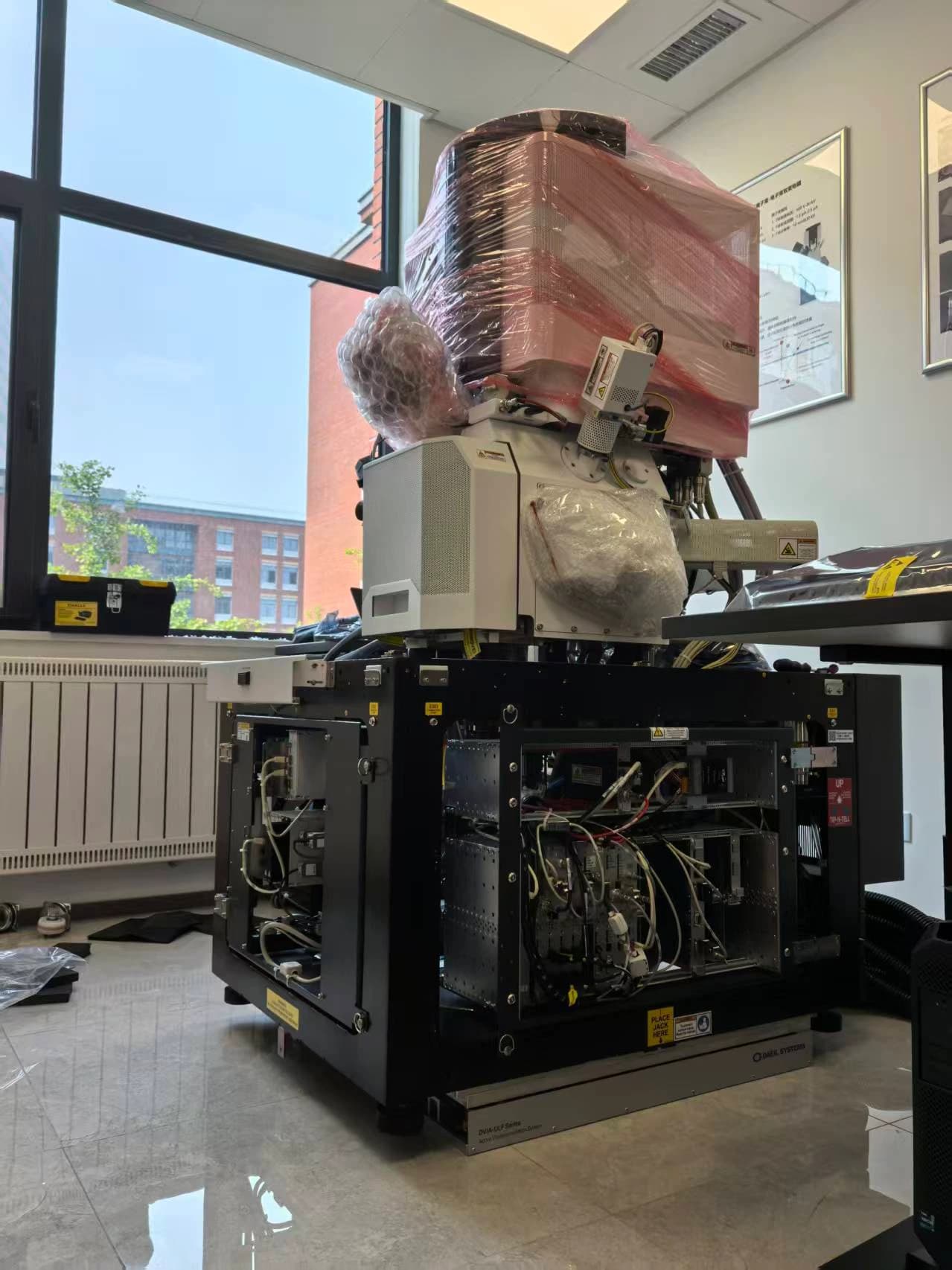
LG Innotek NanoSystem White-Light Interferometer DVIA-ULF1000 Installation Report
Contents
Overview
Following the installation of DVIA-ULF1000 in the 2F cleanroom of Gumi Plant 4 (LG Innotek), tuning and performance verification were performed.
Inspection and vibration measurement were conducted in the IDLE state.
Data is represented in VC Curve format and reference material on the vibration level is provided.
Vibration Isolation System Information
Model: DVIA-ULF1000
Serial Number: 260821S1
Engineer
Gyumin Park · DAEIL SYSTEMS
Tuning Date
26.09.29
Site
2F cleanroom, Gumi Plant 4
End User
LG Innotek
Customer Equipment
Manufacturer: NanoSystem
Equipment: Precision measurement equipment (white-light interferometer)
Model: -
Vibration Specification
-
Equipment Condition
IDLE
Vibration Measurement Equipment
Hardware: DVIA-ULF1000
Software: Monitor_TU_6DOF
Conclusion
1) Installation and Vibration Isolation Performance (IDLE State)
Installation Summary: The installation and tuning of DVIA-ULF1000 for the NanoSystem precision measurement equipment (white-light interferometer) in the 2F cleanroom of Gumi Plant 4 (LG Innotek) was completed.
IDLE (static) performance: The measurement results confirmed vibration levels of VC-F on the Vertical (Z-axis), VC-E on the Left to Right (X-axis), and VC-D on the Front to Back (Y-axis), verifying excellent vibration isolation performance.
2) On-site Measures and Dynamic Performance Test Progress
Day 1 (9/28):
After the initial installation and tuning, attempts were made to verify performance in the static state and stability against eccentricity changes during stage operation.
Because the shortest length of the level feet under the top equipment was similar to the ULF unit height, an interference (collision) issue occurred between the level feet and the floor during stage operation, and the work was carried over to next-day rework for height correction.
Day 2 (9/29):
After placing a rubber isolation pad under the vibration isolation unit to secure height, the reinstallation and retuning were completed.
Actual measurement performance verification: After loading a dummy wafer and running the recipe (X/Y-axis stage movement), a performance test under the stage-stopped condition showed that vibration was significantly improved compared to before, confirming that normal equipment operation is possible.
3) Follow-up Plan and Recommendations
Unit position fixation: To prevent unit position displacement during continuous stage operation and to prevent the installed equipment from falling, anchoring to the floor with anchor bolts is recommended.
Measurement Data Summary
| Measurement Point | Vibration Specification | Measured Axis | Measured Result | |
|---|---|---|---|---|
| Floor | DVIA-ULF1000 | |||
| 1. Floor 2. DVIA-ULF1000 | See Section 8 | Vertical (Z-axis) | Operating Theatre (ISO) | VC-F |
| Left to Right (X-axis) | Operating Theatre (ISO) | VC-E | ||
| Front to Back (Y-axis) | Operating Theatre (ISO) | VC-D | ||
Measurement Data
Vertical (Z-axis)
Z-axis — Autospectrum
Z-axis — VC Curves
Left to Right (X-axis)
X-axis — Autospectrum
X-axis — VC Curves
Front to Back (Y-axis)
Y-axis — Autospectrum
Y-axis — VC Curves
Installation Photos
Reference
The table below classifies vibration levels based on IEST-RP-CC012.2.
Notes:
1. As measured in one-third octave bands of frequency over the frequency 8 to 80 Hz (VC-A and VC-B) or 1 to 80 Hz (VC-C through VC-G).
2. The detail size refers to the width in the case of microelectronics fabrication, the particle (cell) size in the case of medical and pharmaceutical research, etc. It is to imaging associated with probe technologies, AFMs, and nanotechnology.
Share this Case Study
Case Study Information
Related Case Studies
Thermo Fisher Helios 5CX FIB-SEM DVIA-ULF1000 Installation Report
ASM ZEISS GeminiSEM 560 DVIA-ULF1000 (260415R5) Installation Report