QRT DVIA-ML3000 (251111R3) Installation Report — 2026.01.26
Contents
Customer
QRT
Engineer
이채원
Measurement date
26.01.26
Report written date
26.01.26
Overview
Vibration isolation platform
Model: DVIA-ML3000
Serial Number: 251111R3
Inspection date
N/A
Installation site
한국나노기술원 1층 QRT 연구실
End user
N/A
Customer equipment
N/A
Equipment specification
Equipment status
장비 설치 및 Turned Off
Vibration measurement instruments
10.1) Brüel & Kjær LAN-XI DAQ Type 3050 DAQ
Hardware: B&K Front End Type 3050-A-040
Software: B&K Pulse Labshop 22 Version
10.2) Accelerometer
PCB Accelerometer
Model: 393B05
Measurement setup
F Span: 200 Hz
Lines: 3200
Averaging: Spectrum Averaging
Engineering Units: m/s
Window: Hanning
Overlap: Max
Conclusion
The mechanical installation of the DVIA-ML3000 was inspected, and basic utilities required to operate the platform were connected via CDA and power cables.
After checking sensor and actuator signal status, initial control parameters were set and first-pass tuning was performed for the site environment.
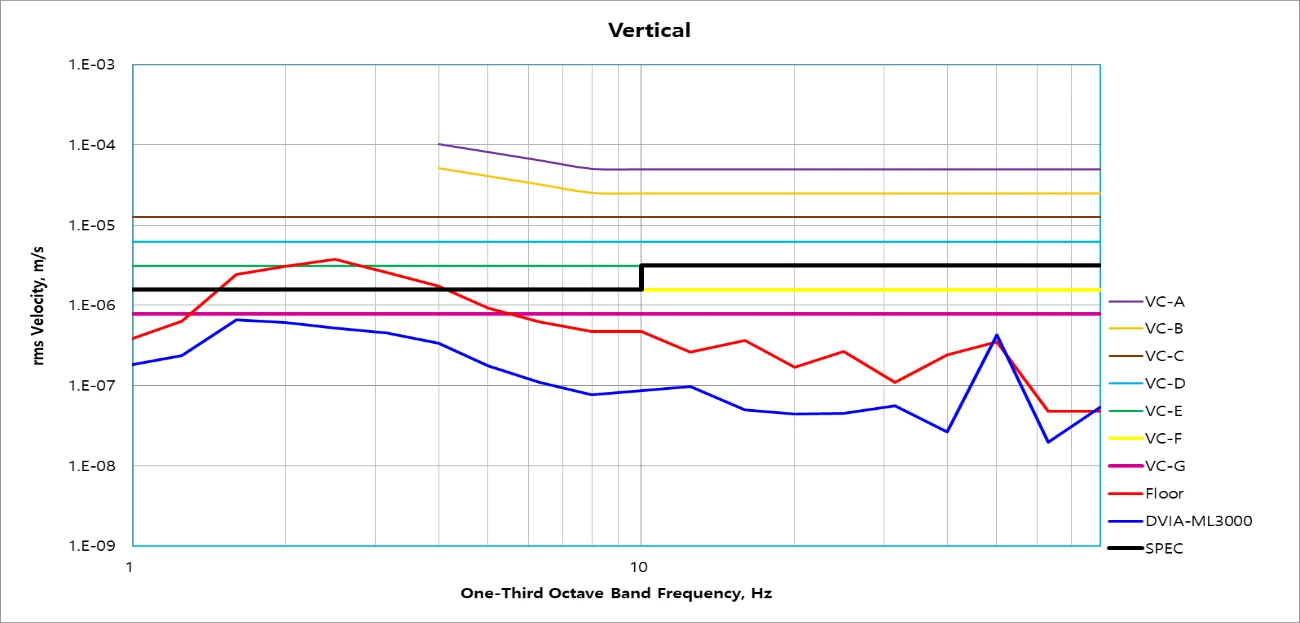
With the DVIA-ML3000 On, the equipment vibration specification was confirmed to be met in all directions.
After normal operation of the DVIA-ML3000 was confirmed, the team demobilized following platform Turn off for Spectra 200 setup.
Measurement data
| Measurement site | Direction | Vibration spec | Floor vibration (μg) | DVIA-ML3000 (μg) | Floor result | DVIA-ML3000 result |
|---|---|---|---|---|---|---|
| 한국나노기술원 1F QRT 연구실 1. 바닥진동 2. DVIA-ML3000 | Vertical | 확인 불가 | 390 @ 40 Hz | 1.39 @ 40 Hz | ✓ PASS | ✓ PASS |
| Left to Right | 44.9 @ 31.5 Hz | 19.8 @ 31.5Hz | ✓ PASS | ✓ PASS | ||
| Front to Back | 9번 항목 참조 | 42.5 @ 40 Hz | 1.61 @ 40 Hz | ✓ PASS | ✓ PASS |
Data and Image
Vertical VC Curves
Vertical Autospectrum
Vertical Transmissibility
Left to Right VC Curves
Left to Right Autospectrum
Left to Right Transmissibility
Front to Back VC Curves
Front to Back Autospecturm
Front to Back Transmissibility
Reference
Generic Vibration Criteria
Notes:
- As measured in one-third octave bands over 8-80 Hz (VC-A/B) or 1-80 Hz (VC-C through VC-G).
- Detail size refers to width in microelectronics fabrication or particle size in medical research.
Share this Case Study
Case Study Information
Related Case Studies
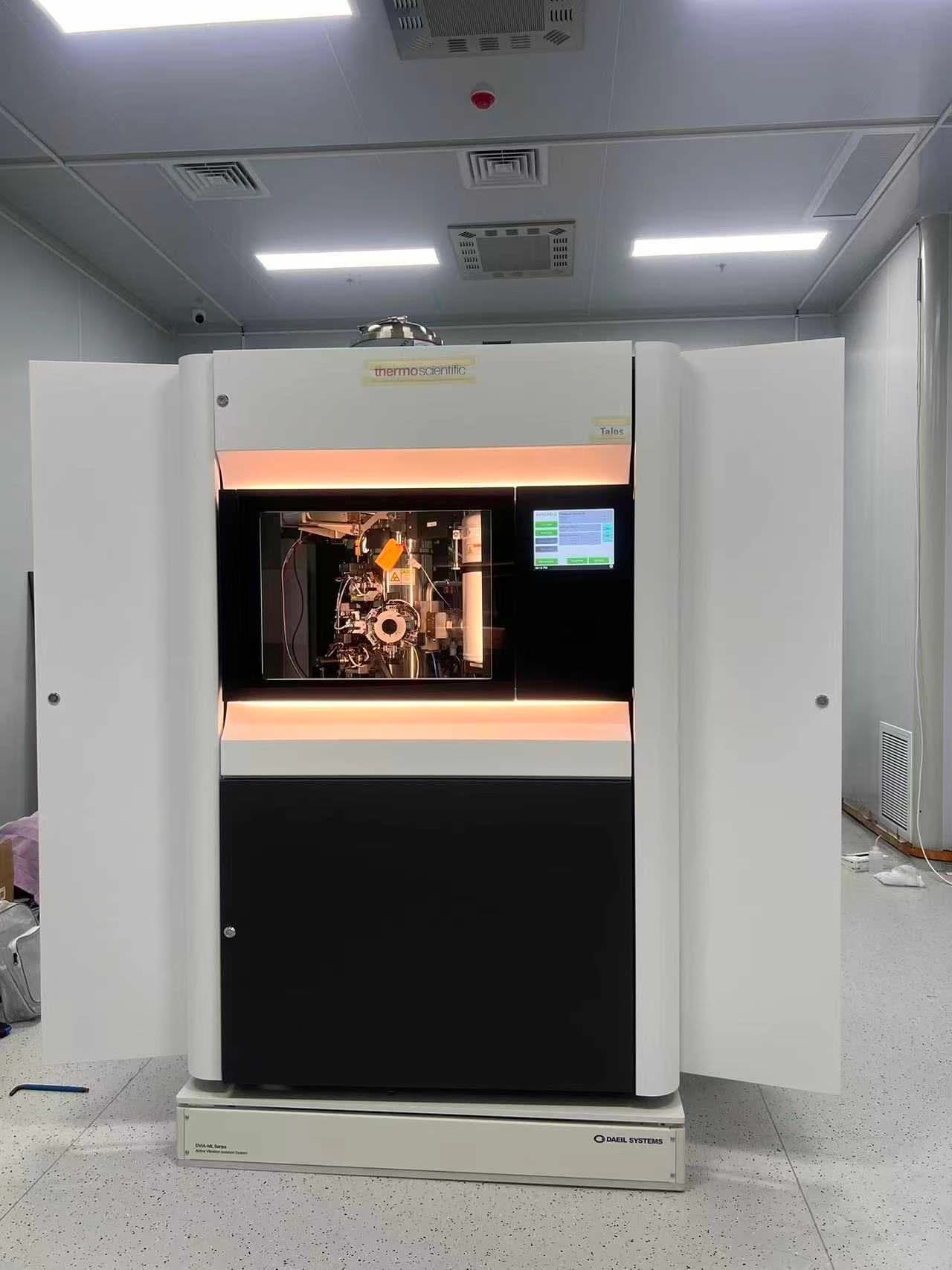
Guangzhou GRG Thermo Fisher Talos TEM DVIA-ML3000 (260128R4) Installation Report

Tier-1 Semiconductor Hwaseong ZEISS Xradia 730 Versa DVIA-ML3000 (251107R2) Installation Report