Pneumatic Support
Engineered for vibration isolation.
See how it is built.
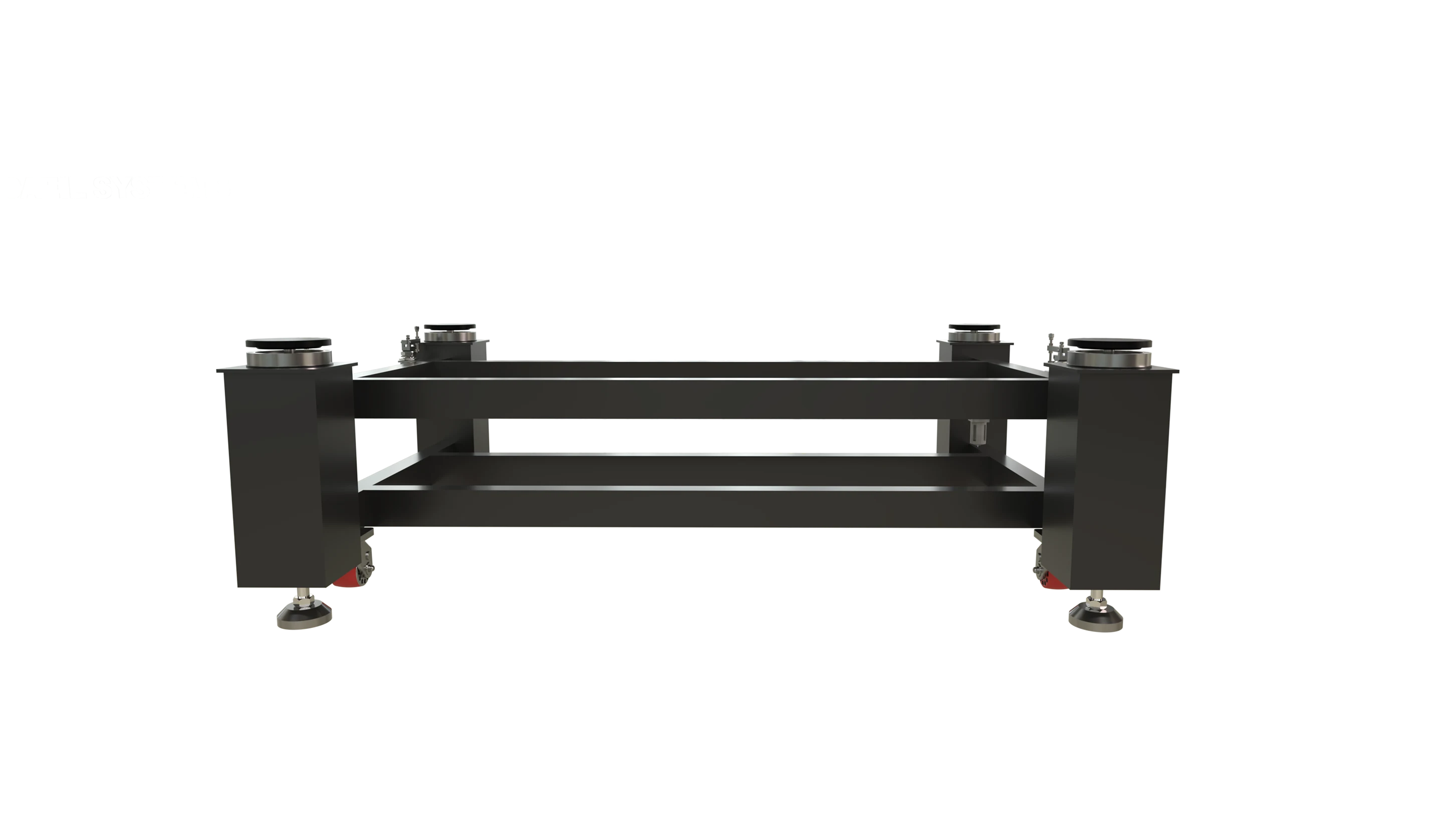
Dual Chamber Architecture.
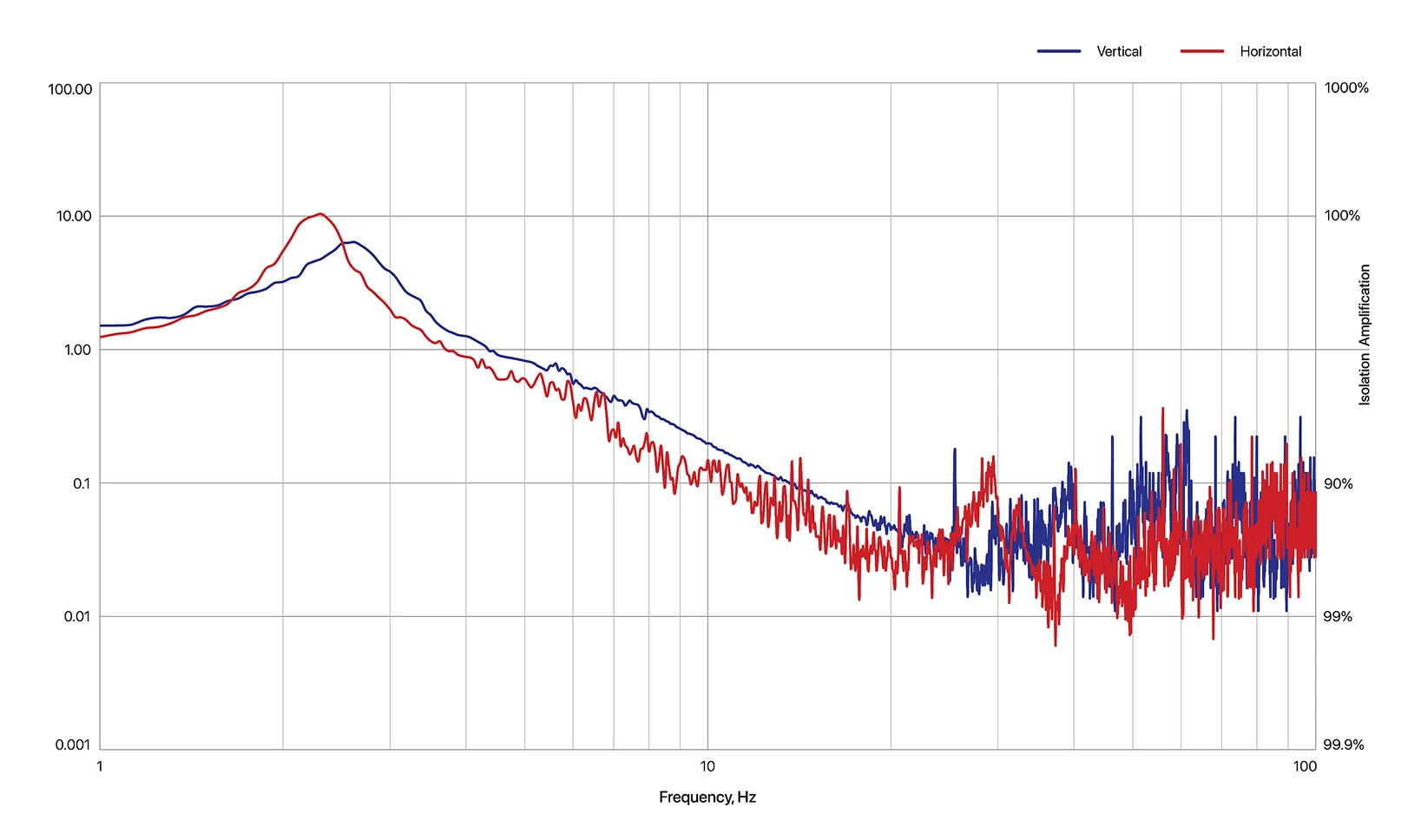
Exceptional isolation performance.
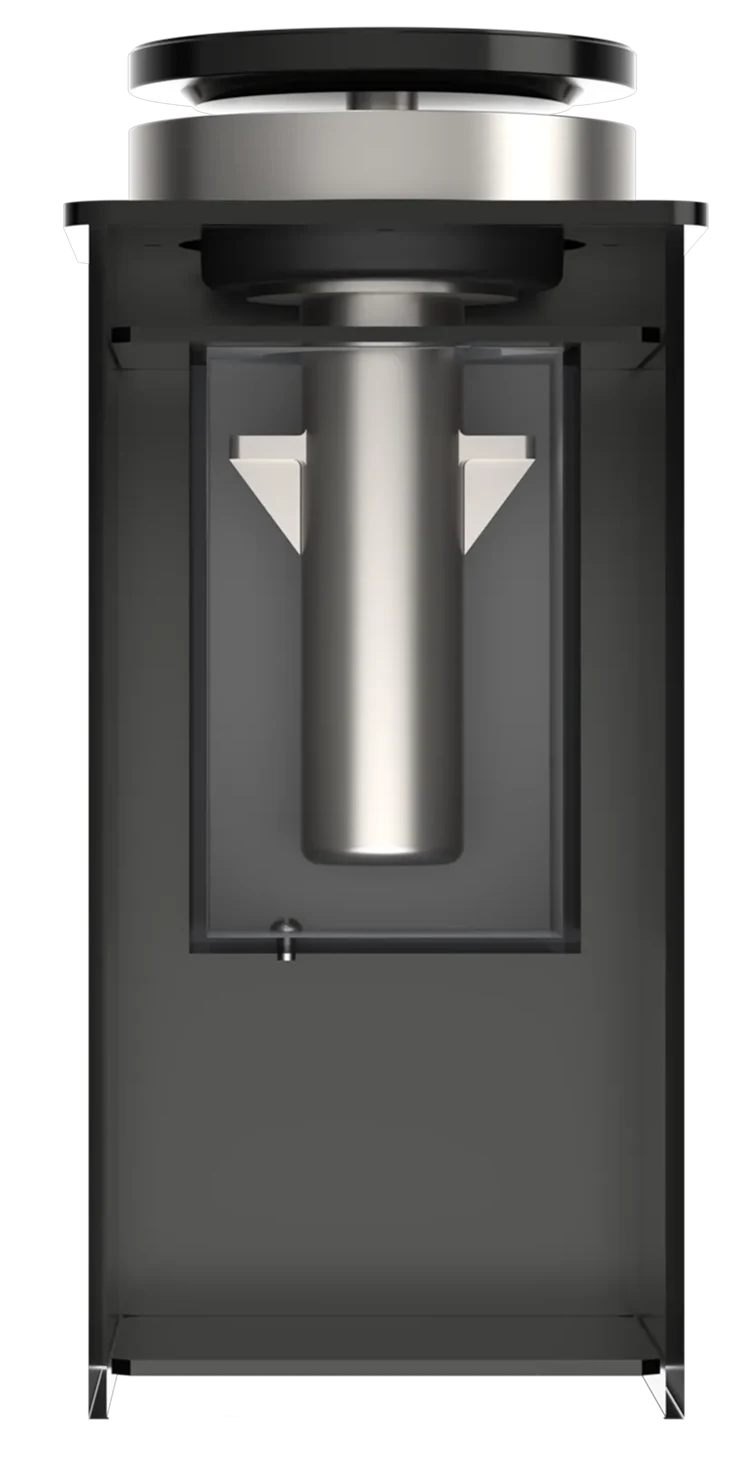
Low-Frequency Vibration Isolation.
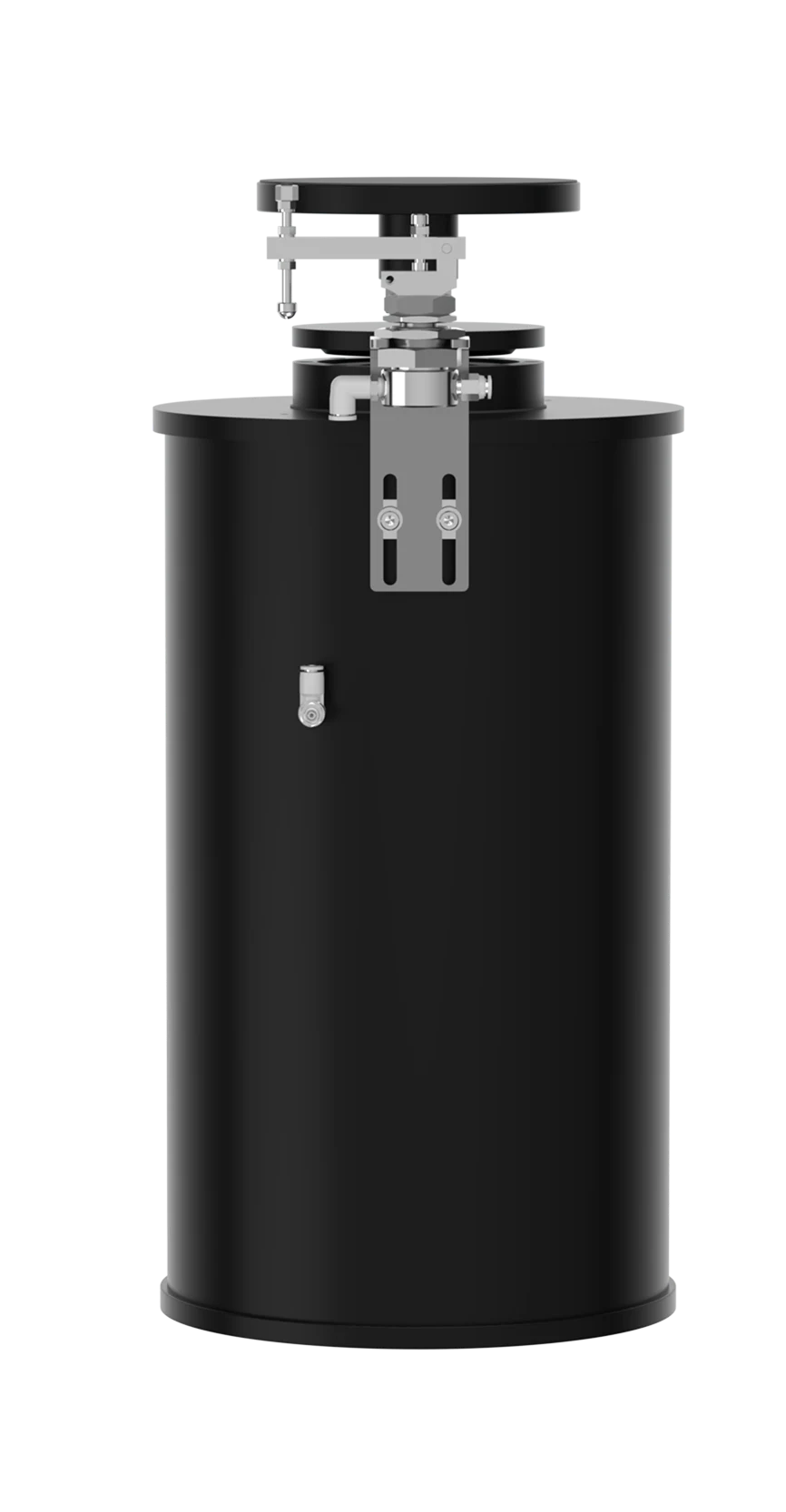
The breakthrough is our Dual-Chamber architecture. Instead of a single, static column of air, we engineered two distinct volumes—a load-bearing chamber and a hidden reservoir—connected by a precision-tuned orifice. It is a design that allows the system to effectively "breathe." When energy enters from the floor, air flows instantly between these chambers, creating a "virtual volume" that behaves as if it is exponentially larger than its physical footprint.
This allows us to cheat the geometry. You get the ultra-low 1.5 Hz natural frequency of a massive isolation system, but in a sleek, compact form factor that never intrudes on your work. It is physics, reimagined: a platform that feels rock-solid to the touch, yet floats your experiments on a cushion of air so capable, the chaotic world outside simply ceases to exist.

Superior damping. Laminar flow energy dissipation.
Vibration control is not just about isolation; it is about management. To prevent the system from oscillating indefinitely after a disturbance, we integrated a sophisticated fluid-mechanical damper directly into the airflow path.
As the piston moves vertically, it compresses the air in the upper compliance chamber. This pressure forces the air to travel through a precision-calibrated orifice into the lower damping reservoir. This isn't a simple vent; it is a tuned restriction. As air molecules crowd through this narrow passage, they generate viscous friction against the orifice walls. This laminar flow resistance effectively strips kinetic energy from the system, converting the mechanical motion of the table into negligible amounts of heat.
Fast settling time. Adaptive damping architecture.
The beauty of this orifice design lies in its passive intelligence. The damping force is velocity-dependent—meaning it reacts proportionally to the severity of the disturbance.
When a researcher bumps the table or a stage accelerates rapidly, the piston moves quickly, forcing air through the orifice at high speed. This generates immediate, high-magnitude damping to stop the sway instantly. Conversely, during normal operation with microscopic ground vibrations, the air moves slowly and freely, offering almost zero resistance. The result is a system that remains "soft" for isolation but becomes "rigid" to stop oscillation, ensuring your data collection can resume seconds after a disruption.
Gimbal Piston.
Silence in every direction.
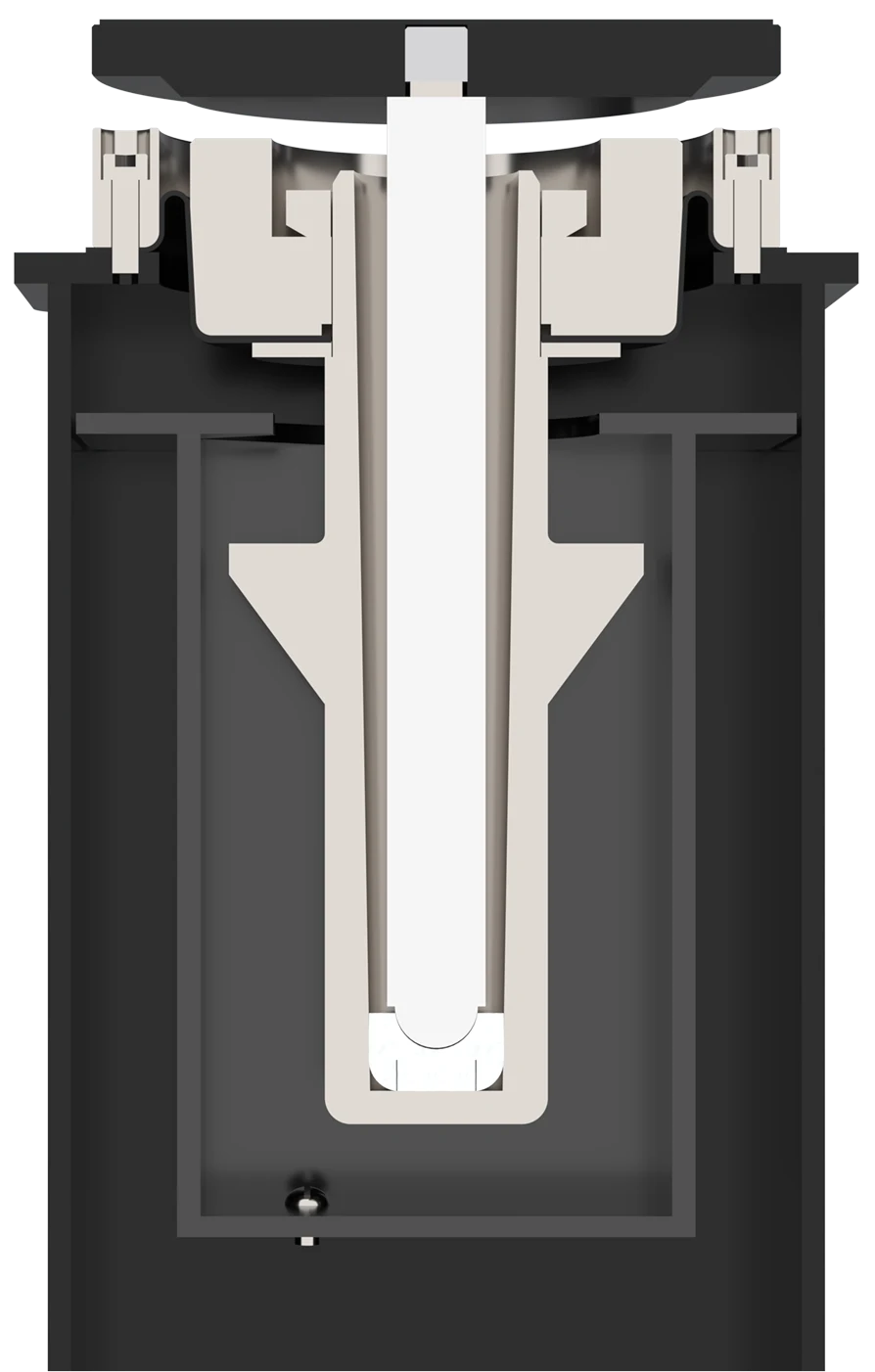
the connection between the earth and your work.The Gimbal Piston breaks this final link. Acting as an inverted pendulum, it allows the support column to swivel with near-zero friction. When the ground shifts horizontally, the mechanism yields, allowing the floor to slide harmlessly underneath your equipment. It ensures that no matter how the room moves, your data remains absolute.
Automatic leveling.
Precision height control
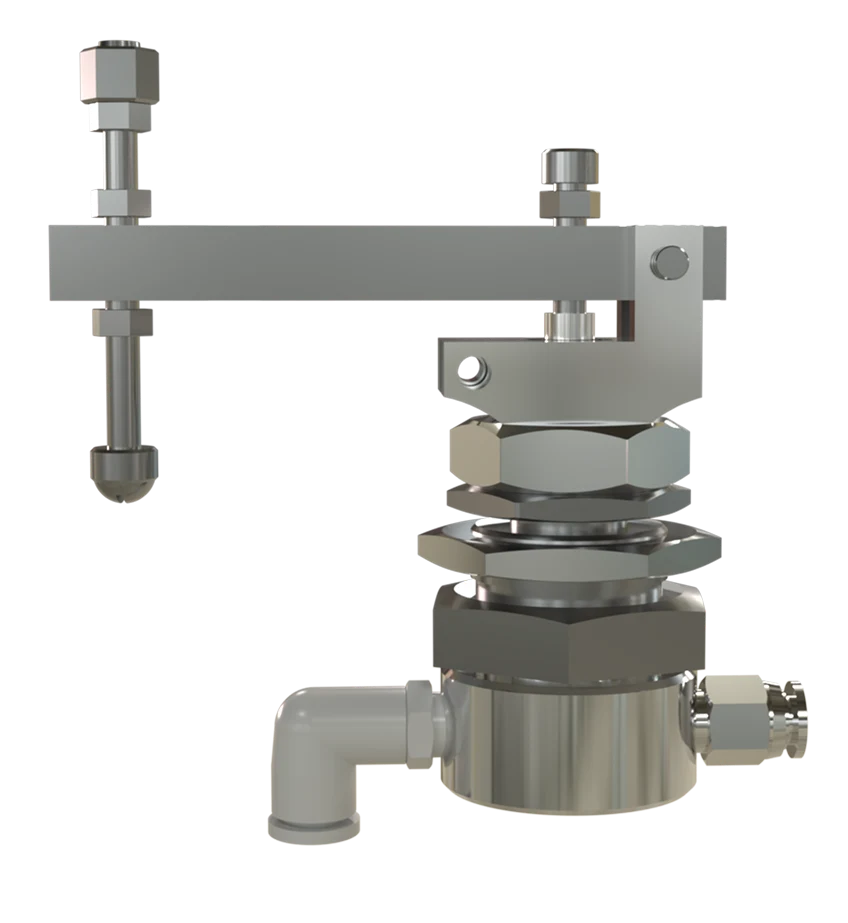
Stability is, at its core, a geometry problem. To solve it, we rely on the only shape that defines a perfect plane: the triangle. Our system utilizes a configuration of three independent leveling valves to establish a rigid reference for your work.
Acting as a kinematic tripod, these sensors act as the system's nervous system, continuously monitoring the table's position. The moment a load shifts—whether you are swapping a heavy laser source or adjusting a multi-axis stage—the valves react. They independently intake or exhaust air, instantly restoring the table to its floating equilibrium.
Repeatability where it counts. For general spectroscopy, our Standard Leveling Valves deliver a dependable repeatability of ±1.0 mm. But for coupled laser systems where every micron matters, our Precision Leveling Valves tighten that control to ±0.05 mm. It ensures that your optical axis stays true, no matter how your experiment evolves.
Flexible configurations for every lab environment.
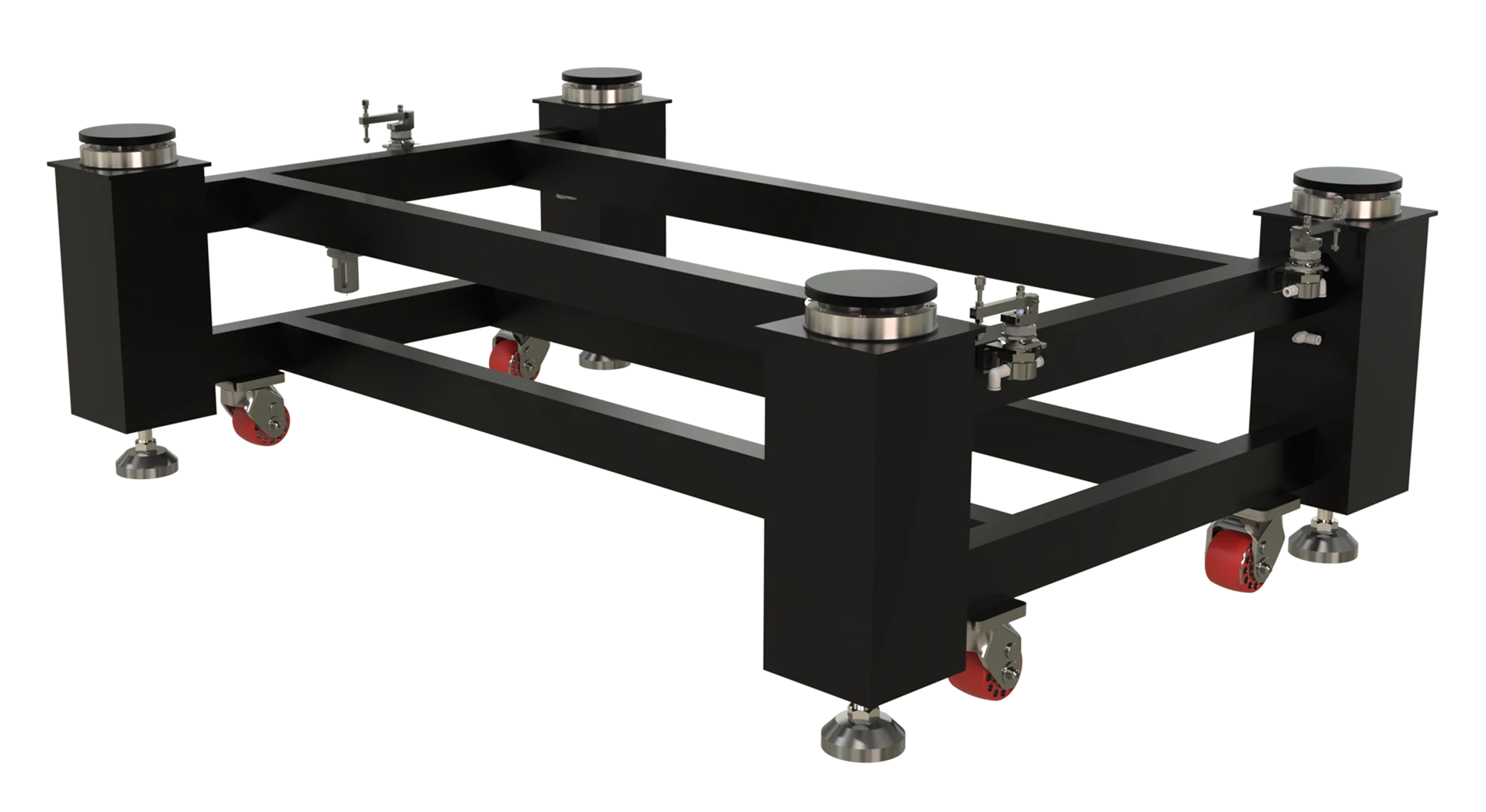
This design integrates heavy-duty casters directly into the frame, transforming a static optical table into a mobile workstation. It is the ideal choice for dynamic laboratories where layout changes are frequent and rapid deployment is essential. You get a clean, repeatable setup that preserves your precise alignment, no matter how often you reconfigure your space.
Performance
Specifications
| Tie-Bar Frame | Self-Standing Frame | |
|---|---|---|
| Frame Structure | ||
| Frame Material | Steel | |
| Frame Type | Tie-Bar Frame | Independent Supports |
| Mobility | Integrated Casters | Not Included |
| Vibration Isolation | ||
| Isolation Method | Pneumatic Isolation | |
| Natural Frequency | 1.5 – 3 Hz (vertical/horizontal) | |
| 10 Hz Attenuation | 80 – 99% | |
| Leveling & Load | ||
| Leveling Valve | 3 EA | |
| Leveling Repeatability | ±1.0 mm, ±0.05 mm (optional) | |
| Max Load Capacity | 2000 kg | |
| Required Air Supply | ||
| Supply Pressure | 4 - 6 bar | |
| Flow Rate | 10 L/min | |
| Air Connection | ⌀ 6 mm air fitting | |
Ordering Information
Width Range: 1000 - 3600 mm
Depth Range: 600 - 1500 mm
Height Options: 400, 500, 600, 700, 800 mm
Board Thickness: 200, 300, 400 mm
Type: Tie-Bar or Self-Standing
Optional Accessories
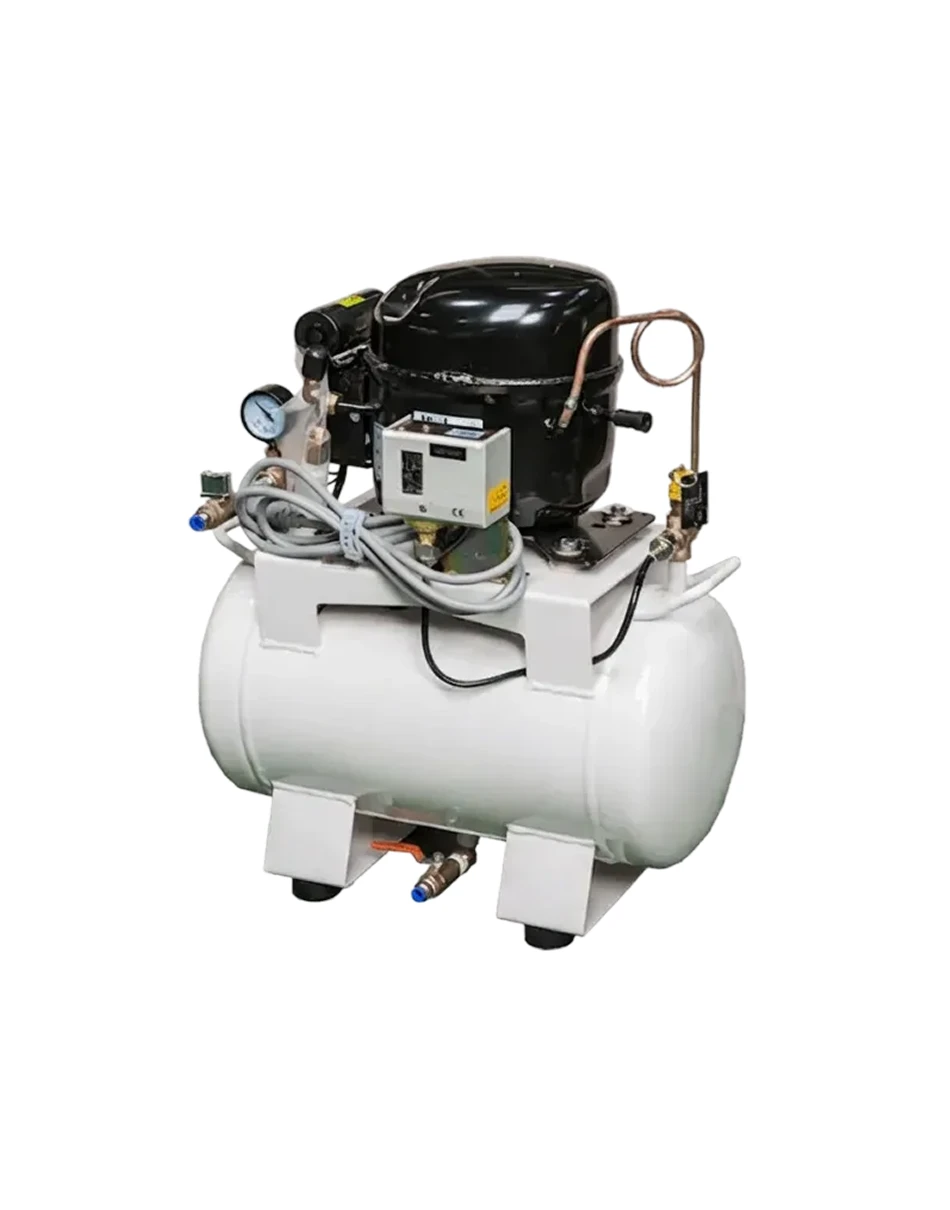
Air Compressor.The DAC portable air compressor provides a stable air supply for pneumatic isolation systems when facility air is unavailable or inconsistent.
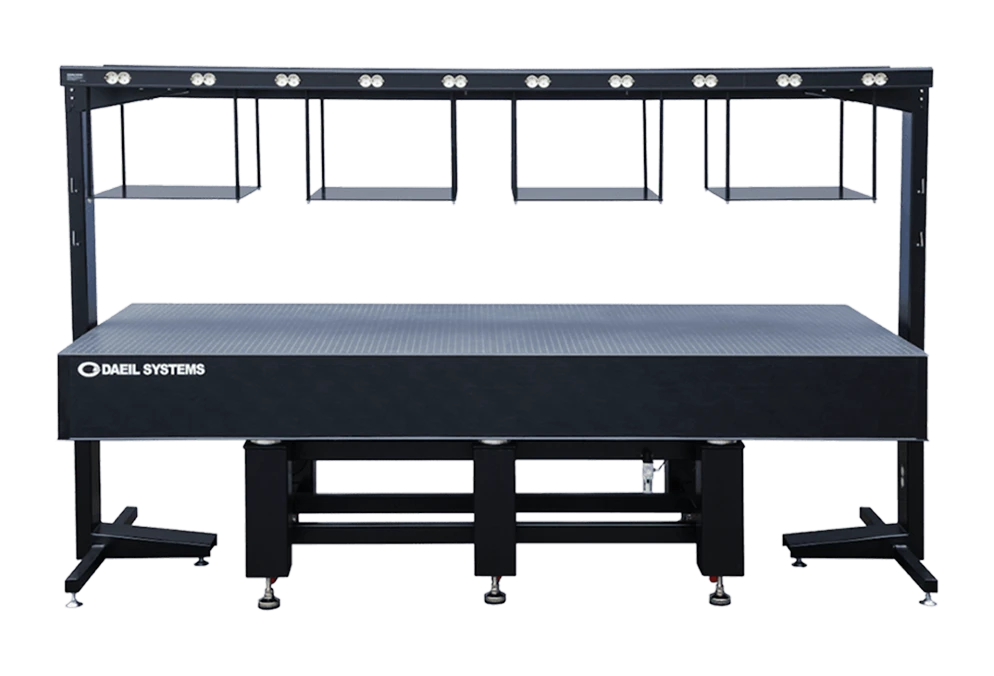
Overhead Shelf System.Overhead Optical Table Shelf Systems streamline lab space, supporting power supplies, controllers, oscilloscopes, and more. Dual-sided top outlets offer easy access to power, while adjustable shelves provide flexible, efficient organization.
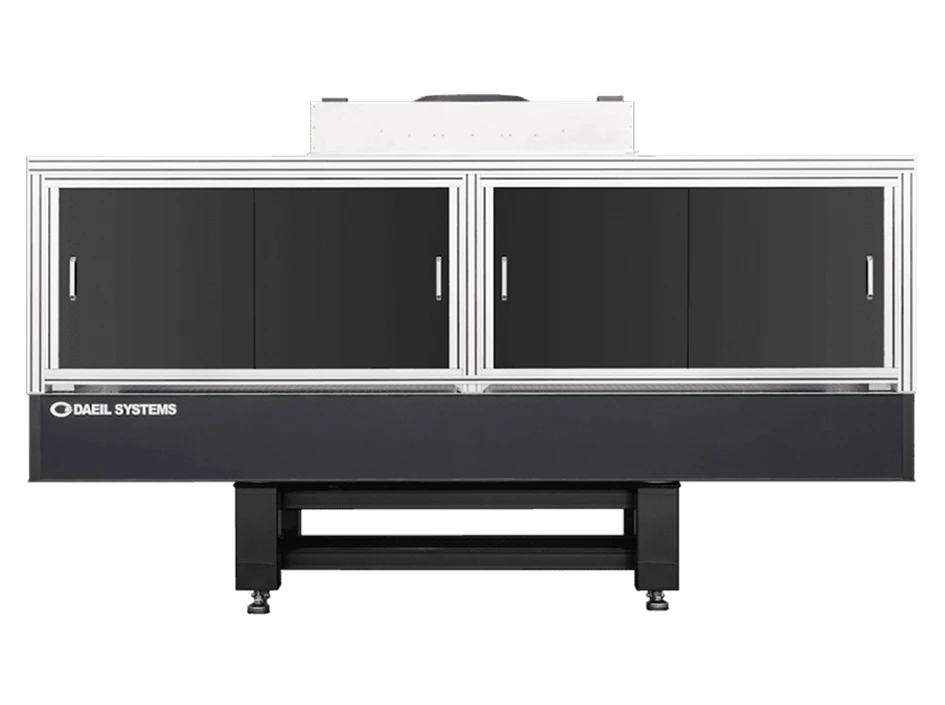
Table Enclosure.Our optical table enclosure is a fully custom, rigid housing designed to protect sensitive experiments from dust, drafts and ambient light while keeping your setup accessible and easy to work with.