Seoul National University — ZEISS Gemini M-1000 P3 vibration environment measurement (2014-06-12)
Contents
Vibration environment measurement results (Seoul National University Precision Machinery Joint Research Building)
Overview
To determine whether the vibration environment after applying the M-1000 P3 isolation platform satisfies the user's requirements.
Measurement date: 2014. 6. 12 (Thursday). Measurer: Choi Seong-won.
3. Measurement conditions and results
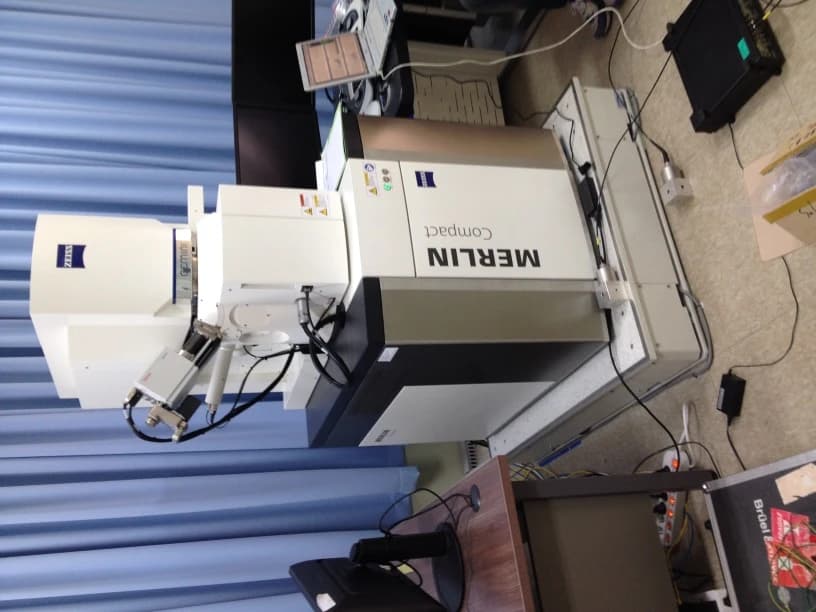
Carl Zeiss host equipment was operating during tuning and vibration measurement.
Measurement locations were the side of the isolation platform top plate (top) and the floor near the platform base (base).
Measurement setup — photograph 1
Measurement setup — photograph 2
Results summary
| Test direction | Base | Top | Transmissibility [dB @ 10 Hz] |
|---|---|---|---|
| ACTIVE Z | D | G | -30.8 |
| ACTIVE X | E | G | -34.7 |
| ACTIVE Y | F | G | -34.3 |
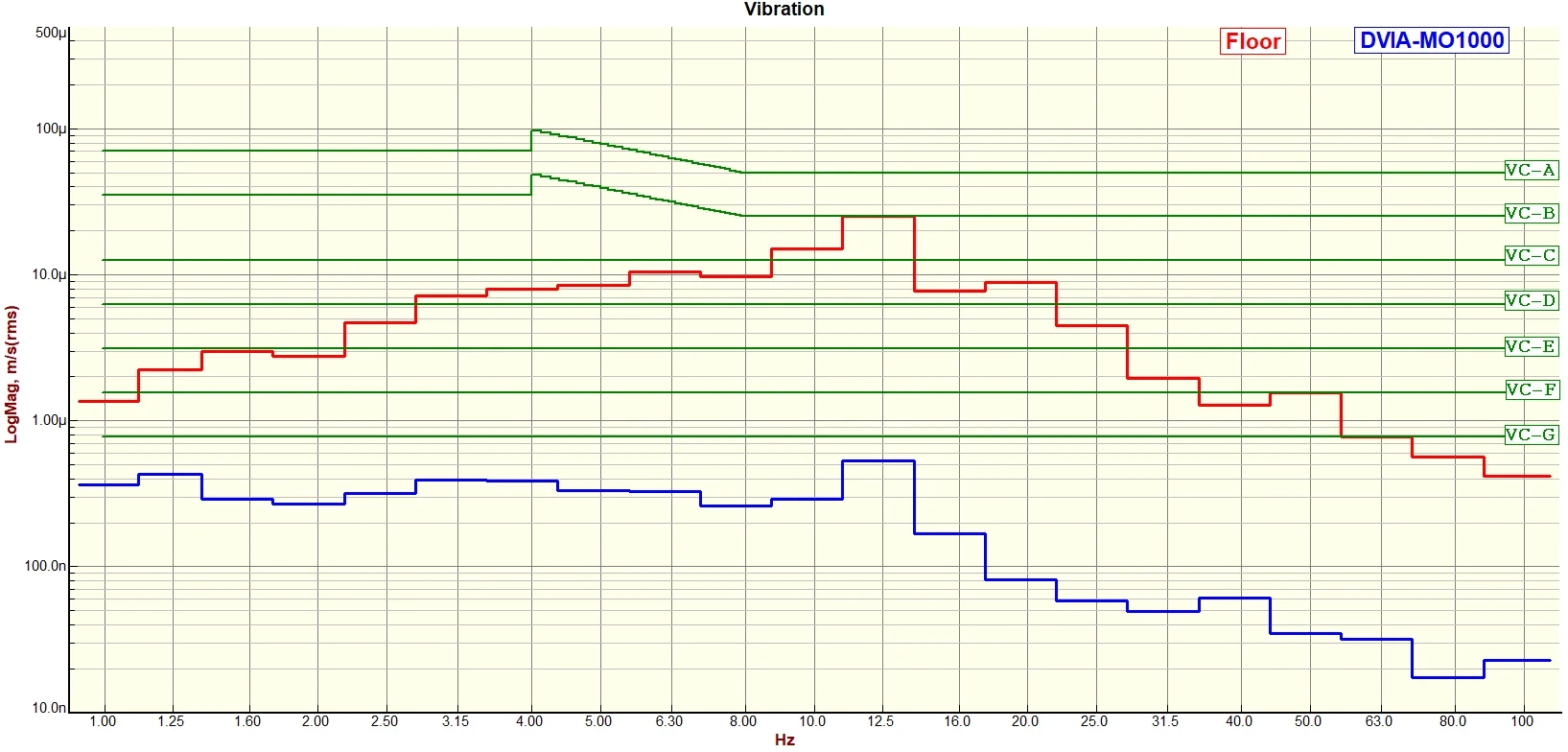
Isolation platform intrinsic performance is satisfactory at approximately −30 dB in all directions.
With active control, the vibration environment on the platform top is G class and satisfactory.
The SEM's built-in passive isolation may affect performance in the 1–6 Hz range; the measurement results confirm this is not an issue.
Transmissibility graphs
Transmissibility (Z and X axes)
Transmissibility (Y axis)
Octave band
Octave band (Active Z and Active X)
Octave band (Active Y)
Reference
Generic Vibration Criteria
Notes:
- As measured in one-third octave bands over 8-80 Hz (VC-A/B) or 1-80 Hz (VC-C through VC-G).
- Detail size refers to width in microelectronics fabrication or particle size in medical research.
Share this Case Study
Case Study Information
Related Case Studies
Seoul National University — M-1000 P3 vibration environment measurement after service (ZEISS equipment, 2015-01-27)
Seoul National University Thermo Fisher Scientific Glacios DVIA-MB1000 (210121R5) Installation Report