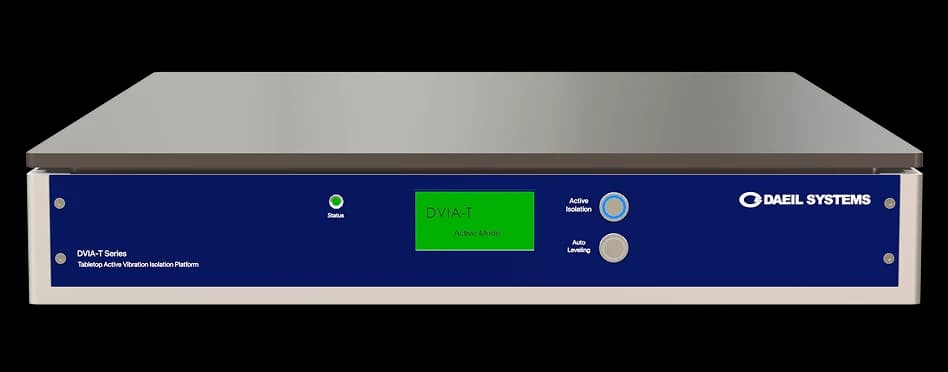
Tabletop Platform
DVIA-T
Nanoscale precision on any desk. 80–90% isolation at 1 Hz.
Tabletop Microscopy
Active vibration isolation cancels floor vibration in real time: sensors measure motion, a digital signal processor computes a counter-force, and actuators apply it — including the low-frequency vibration that passive isolators cannot touch. The DAEIL SYSTEMS DVIA series applies this closed-loop control in all six degrees of freedom, isolating from 0.5 Hz and keeping electron microscopes, AFMs, and semiconductor metrology tools at full resolution. Built by a vibration isolation specialist since 1984.
Tabletop Platform
Nanoscale precision on any desk. 80–90% isolation at 1 Hz.
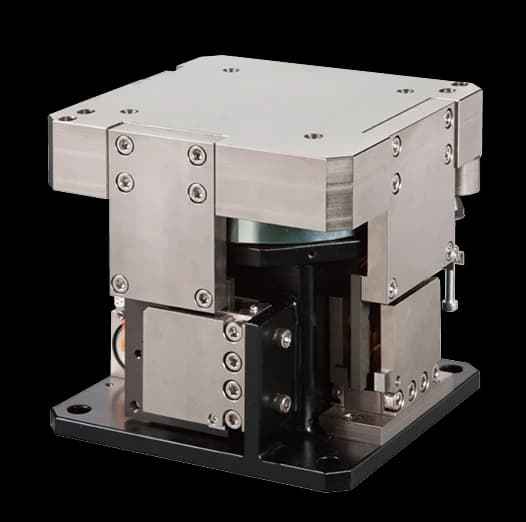
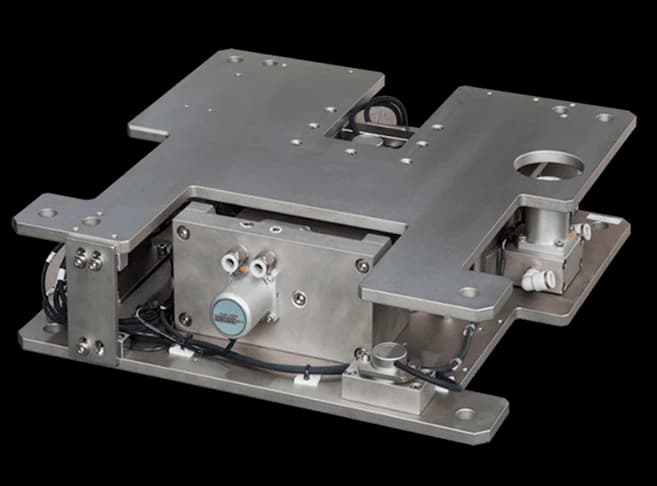
OEM Isolation Module
Seamlessly embedded. Instruments that refuse to shake.
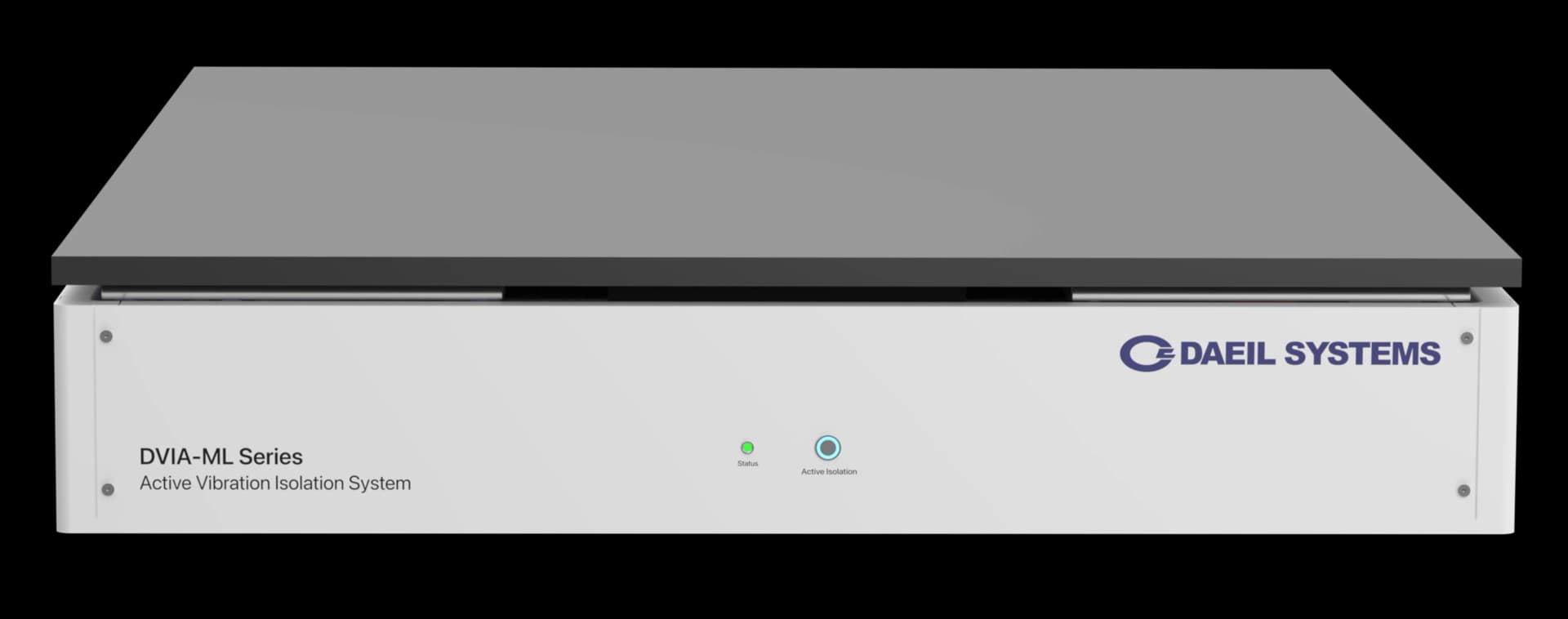
custom active platform
Active control from 0.5 Hz. Multi-axis. Uncompromising.
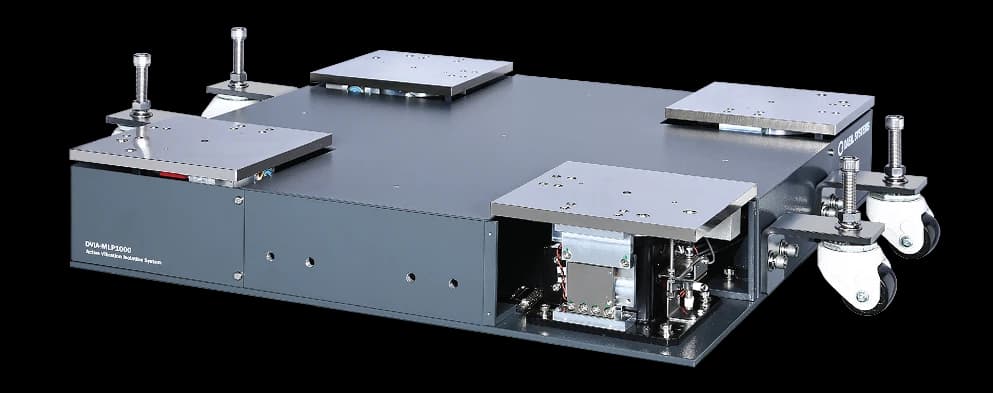
Custom active platform for Thermo Fisher
Large-scale stability. Engineered for the most demanding payloads.
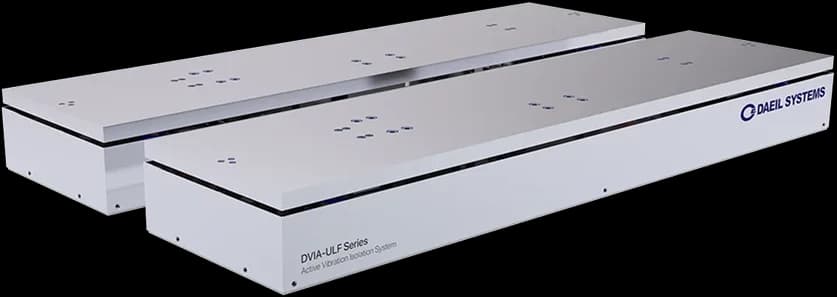
modular active isolator
80–90% at 1 Hz, without power. Pure mechanical elegance.
active isolation system for semiconductor
Purpose-built for semiconductor metrology. Clean-room ready.
Active vibration isolation is closed-loop vibration cancellation: instead of absorbing floor motion with springs or air, an active system measures vibration directly and generates an equal and opposite force to remove it. Every active vibration isolation system combines three elements — sensors to measure motion, a controller to compute the response, and actuators to apply it.
DVIA systems run two control paths at once. On DVIA's electromagnetic platforms, the feedback loop uses geophone velocity sensors (sensitivity 2.55 V/in/s, approximately 100.4 V/m/s) mounted on the isolated platform to measure residual vibration — the motion that actually reaches your instrument. A digital signal processor computes the required counter-force, and electromagnetic actuators apply it in real time, with response under 0.5 ms on some models. The clean-room DVIA-P implements the same principle with accelerometers and pneumatic servo actuators. The feedforward loop works ahead of the payload: floor-mounted sensors detect incoming ground vibration, and the controller cancels it before it propagates into the platform.
Both loops operate simultaneously in all six degrees of freedom — three translations (X, Y, Z) and three rotations (θx, θy, θz) — because real floors do not simply heave vertically; they pitch, roll, and shear. Full six-axis control closes every path, across an active bandwidth that starts at 0.5 Hz and extends to 200 Hz on models such as the DVIA-ML.
The difference between active and passive vibration isolation comes down to low frequency. A passive pneumatic isolator is a spring with a natural frequency of 1.2–3.0 Hz: it amplifies vibration near that resonance and isolates well only above roughly 5–10 Hz. Active systems remove the resonance from the equation and start isolating at 0.5 Hz.
| Aspect | Active vibration isolation | Passive isolation (pneumatic) |
|---|---|---|
| Isolation onset | Begins isolating at 0.5 Hz — below the natural frequency of any passive pneumatic isolator | Effective isolation only above roughly 5–10 Hz; the band below is transmitted or amplified |
| Isolation at 1 Hz | 80–90% of floor vibration removed; 90% or more at 2 Hz and above (DVIA-ML) | None — vibration is amplified near the 1.2–3.0 Hz resonance |
| Resonance amplification | None; the control loop adds damping instead of a resonant peak, so transmissibility stays below unity | Transmissibility rises above unity near the natural frequency — the mount makes this band worse |
| Response to disturbance | Actuators cancel motion in real time, with response under 0.5 ms on some models | The lightly damped air spring rings at its natural frequency until the energy dissipates |
| Axes of control | All six degrees of freedom — X, Y, Z, θx, θy, θz — with active bandwidth from 0.5 Hz (up to 200 Hz, model-dependent) | No control loop; behavior fixed by spring stiffness and damping at installation |
| Ground vibration handling | Feedforward floor sensors detect incoming ground vibration and cancel it before it reaches the payload | Filtered only above resonance; everything below passes through or is amplified |
DVIA active systems engage at 0.5 Hz and stay effective up to 200 Hz on models such as the DVIA-ML. At 1 Hz — where a pneumatic isolator is near peak amplification — the DVIA-ML removes 80–90% of floor vibration. At 2 Hz and above, isolation is 90% or greater, in all six degrees of freedom.
Transmissibility tells the story. Read as the ratio of platform motion to floor motion at each frequency, a passive isolator's curve rises above unity near its 1.2–3.0 Hz natural frequency: the platform literally moves more than the floor. The DVIA curve has no such peak. There is no resonance to excite, because the control loop cancels motion instead of storing it — and therefore no band in which the isolator makes things worse.
The low end matters most: building motion concentrates vibration energy below 5 Hz, exactly where passive mounts amplify or transmit. In facility terms, performance maps to the VC (vibration criterion) curves used to specify electron microscopy and metrology environments. The DVIA-ML series meets VC-B up to VC-G class environments in supported instrument classes.
Active vibration isolation is built for instruments that resolve nanometers on floors that move. Electron microscopes — SEM, TEM, and cryo-EM — are the defining case: the column acts as a lever, turning small platform rotations at 1–3 Hz into image blur at the sample. The DVIA-ML isolates them from 0.5 Hz, carries payloads up to 6,000 kg (ML6000), and is designed to emit less than 0.05 μT of magnetic field — safe for electron optics. DVIA-MLP applies the same engineering to Thermo Fisher SEMs.
AFM and SPM are just as exposed: floor vibration appears directly in the sub-nanometer height signal. DVIA-ULF and the tabletop DVIA-T keep them still. In the fab, the clean-room-ready DVIA-P brings active isolation to CD-SEM, DR-SEM, and photomask inspection, where measurement repeatability depends on a stable stage. E-beam lithography, X-ray metrology, and NMR complete the set — each limited by low-frequency vibration that a passive 1.2–3.0 Hz pneumatic mount cannot remove. For instrument makers, the DVIA-M OEM module embeds active isolation inside the tool itself.
An active vibration isolation system cancels vibration with a closed control loop instead of a passive spring. Sensors measure vibration, a digital signal processor computes an equal-and-opposite counter-force, and actuators apply it in real time. The DAEIL SYSTEMS DVIA series controls all six degrees of freedom, has no low-frequency resonance, and starts isolating at 0.5 Hz, with active bandwidth up to 200 Hz depending on model.
Two control loops run in parallel. Feedback: sensors on the isolated platform measure residual vibration, and a DSP drives the actuators to cancel it, with response under 0.5 ms on some models. Feedforward: sensors on the floor detect incoming ground vibration and cancel it before it reaches the payload. DVIA systems apply both across all six degrees of freedom.
A passive pneumatic isolator is a spring with a natural frequency of 1.2–3.0 Hz. It isolates well above roughly 5–10 Hz but amplifies vibration near resonance. An active system measures vibration and cancels it: isolation starts at 0.5 Hz, reaches 80–90% at 1 Hz (DVIA-ML), and there is no resonance amplification at any frequency — exactly where passive mounts perform worst.
When the vibration limiting your instrument sits below about 5 Hz. Building motion concentrates energy at low frequency, where passive pneumatic isolators amplify rather than isolate. If a site survey shows peaks in the 1–3 Hz band, or an electron microscope or AFM still shows vibration-induced blur on a passive table, active isolation targets that band directly — and is the practical route to strict VC-class siting requirements.
DVIA systems actively isolate from 0.5 Hz, with bandwidth extending up to 200 Hz depending on model (0.5–200 Hz on the DVIA-ML). At 1 Hz the DVIA-ML delivers 80–90% isolation, and 90% or better at 2 Hz and above, in all six degrees of freedom. This covers the low-frequency band where passive pneumatic isolators either amplify vibration or barely attenuate it — the band that matters most for electron microscopes and nanoscale metrology.
Instruments resolving nanometer or sub-nanometer features: SEM, TEM and cryo-EM, AFM/SPM, e-beam lithography, X-ray metrology, NMR, and semiconductor wafer metrology and inspection (CD-SEM, DR-SEM, photomask inspection). The DVIA lineup covers each: DVIA-ML for electron microscopes up to 6,000 kg, DVIA-P for the fab, DVIA-T for desktop microscopy, and DVIA-M for OEM integration inside the instrument itself.