Fundamentals of Vibration
Basic principles and theory of vibration isolation systems and their applications.
Vibration
Vibration is a mechanical movement around an equilibrium point. In other words, it is a mechanical phenomenon where a dynamic external force is applied onto structures or floors, causing the oscillation motion that repeats itself after an interval of time. Among the sources of vibration, the low frequency vibration is not perceptible during daily activities, and adversely affect vibration-sensitive metrology tools in the fields of semiconductor, display, electron microscopy, life sciences and photonics.
Classification of Vibration
Periodic noise is defined as the known magnitude of the excitation acting on a vibratory system at any given time. It is generally caused by rotating machinery. Random noise is caused by unpredictable excitation such as wind velocity, road roughness, foot and vehicular traffic, and ground motion during various activities.
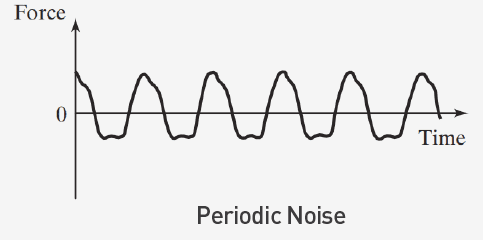
Periodic Noise
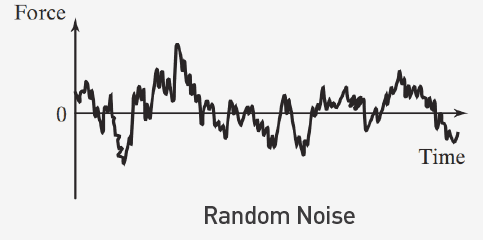
Random Noise
Measurement Unit of Vibration
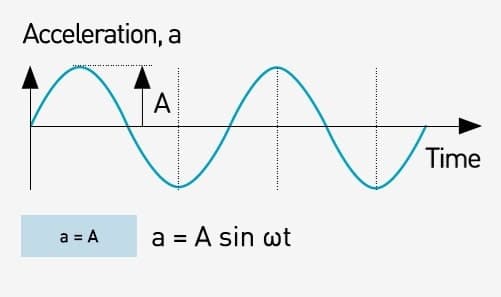
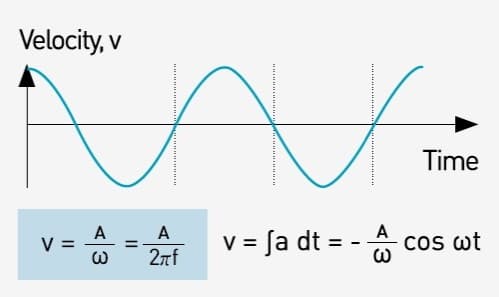
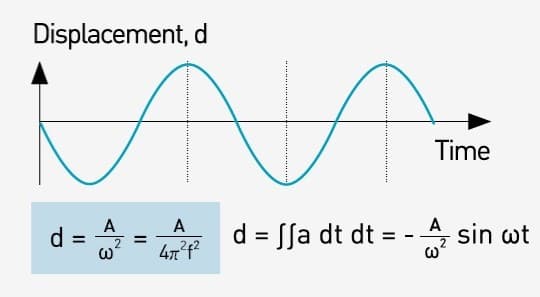
Vibration can be measured in units of displacement, velocity and acceleration. The shape and frequency of the vibration are the same regardless of which of the three measurement units, used to express vibration, except for the difference in the phase. Sinusoidal signals, displacement, velocity and acceleration amplitudes are related mathematically by a function of frequency and time.
| Measurement | Basic Unit | Common Unit | |
|---|---|---|---|
| Displacement | cm | 1㎛ = 10⁻³mm = 10⁻⁴cm | 1mm = 10⁻¹cm = 10⁻³m |
| Velocity | cm/sec | 1m/sec = 10²cm/sec = 10³mm/sec | |
| Acceleration | cm/s²(Gal) | 1g = 980 cm/sec² | 1m/sec² = 10²cm/sec² |
Relationship between Displacement, Velocity and Acceleration
Sources of Vibration
- Ground Vibration
- Acoustic Noise
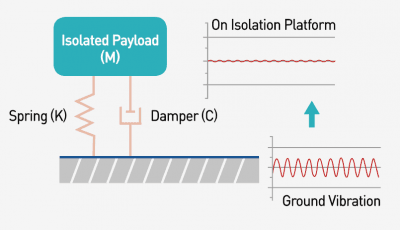
- Direct force applied to a payload installed on a vibration isolation platform
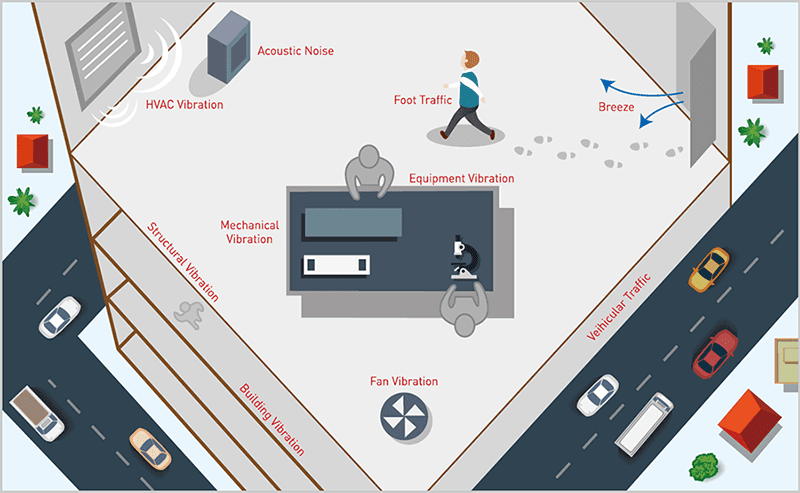
- Ground (seismic) vibrations indicate all the factors that cause vibrations on a floor. The factors include foot and vehicular traffic, wind blowing buildings and HVAC systems.
- Acoustic noises are the air currents caused by the HVAC ventilation.
- A direct force is a force that directly applied to a payload on a vibration isolation platform, including cables connecting instruments and motorized linear stages.
Frequency
Frequency is defined as the number of events of a repetitive motion cycle during the period of 1 second and measured in hertz (Hz).
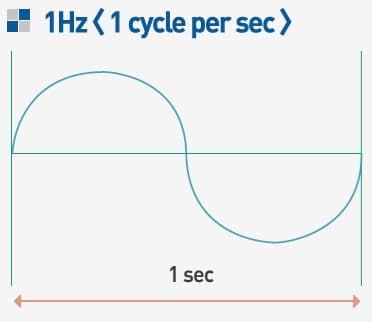
1 Hz
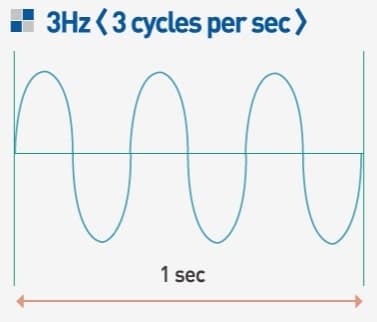
3 Hz
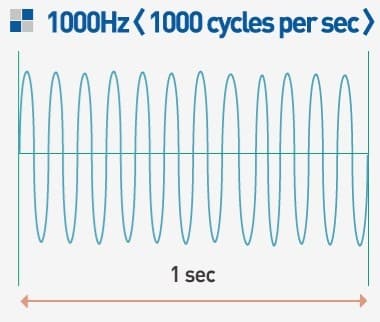
1000 Hz
Natural Frequency
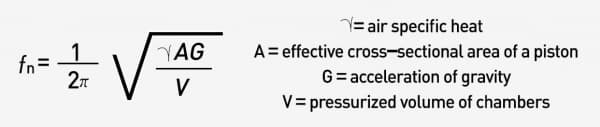
The natural frequency is the frequency at which the system resonates or oscillates when the system is not disturbed by an external force. A higher stiffness and a lower mass indicates the high natural frequency and a lower stiffness and a higher mass indicates the low natural frequency.
Forced Frequency
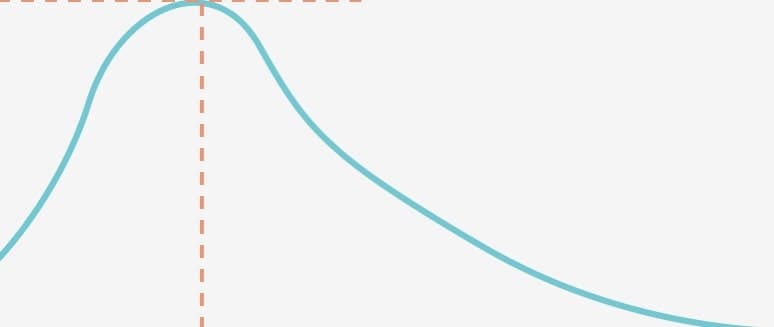
If an object is subject to an external force, resulting vibrations and the frequency of that external force is known as forced frequency. When the forced frequency coincides with the natural frequency of the vibration isolation system, the amplitudes of vibration peaks which is known as resonance.
Resonance
Resonance occurs if a forced frequency coincides with a natural frequency of the system, resulting large oscillations. Frequency at which the response amplitude is a relative maximum is known as resonant frequency.
Measurement of Vibration Amplitude (Quantifying Vibration Level)
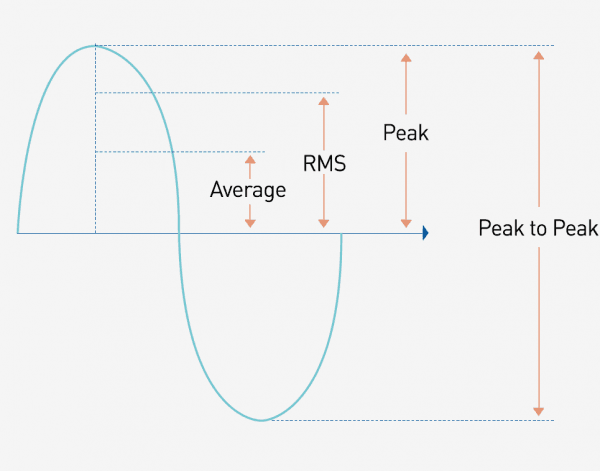
The magnitude of displacement, velocity, or acceleration from its zero value (rest value) is known as amplitude. The amplitude of vibration can be expressed as peak-to-peak, peak, Root Mean Square.
Peak
The peak value only indicates the maximum excursion of the vibration amplitude from the equilibrium point, no account is taken of the time history of the wave.
Peak-to-Peak
The peak-to-peak value indicates the distance from a negative peak to a positive peak.
Root Mean Square (RMS)
The RMS value indicates the square root of the average of the squared values of vibration amplitudes. The RMS value both takes the time history of the wave into account and gives an amplitude value which is directly related to the energy content. The RMS value of a sine wave is 0.707 times the peak amplitude and the RMS value is proportional to the area under the sine wave curve representing the vibration energy. The RMS value is used for the vibration criterion curves with the international standards organization (ISO), which are widely accepted throughout the world as an environmental vibration standard.
Average
The average value indicates an average variation of vibration over time. However, the average value is considered of limited practical interest because it has no direct relationship with any useful physical quantity.
Vibration Isolation
Vibration isolation is defined as the process to isolate an object from sources of vibration. The theory of vibration isolation is to make the natural frequency of the system lower than the forced frequency and suppress the resonance at the natural frequency of the system. As technology advances, the vibration isolation technique is essentially required to isolate vibration sensitive metrology instruments from vibrations.
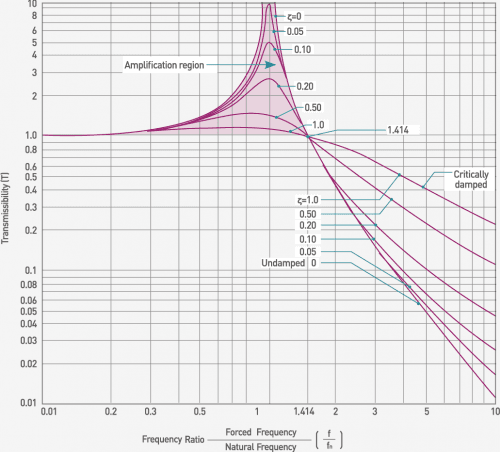
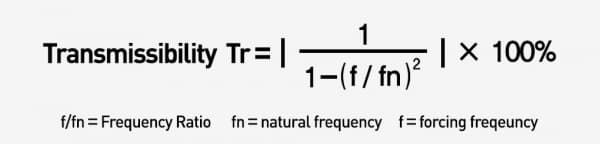
Transmissibility (T) indicates the ratio of the vibration amplitude of the vibration transmitted to a vibration isolated platform to that of the exciting vibration. The efficiency of the vibration isolation improves with the lower natural frequency, meaning that the lower T value is the better vibration isolation performance.
For the frequency ratio in the range (0 < frequency ratio < 1.414), the T is greater than 1 for all values of damping ratio (ζ), indicating vibration amplifications and transmission and damper helps to reduce the vibration amplifications. When the frequency ratio is equal to 1, vibration amplitude is maximized (resonance), and the amplified T value is minimized depending on damping ratio.