Installation Report
DVIA-ULF Series
05-21-2026

Kunming Metallurgical Research Institute ZEISS Sigma 360 DVIA-ULFB700 Installation Report

DVIA-ULF Series
Installation Report
Kunming Metallurgical Research Institute
ZEISS
Sigma 360
FE-SEM
DVIA-ULFB700
250107R2

Overview

Following the installation of DVIA-ULFB700 at Kunming, vibration measurement was performed.

Vibration measurement was conducted with the equipment in the IDLE state.

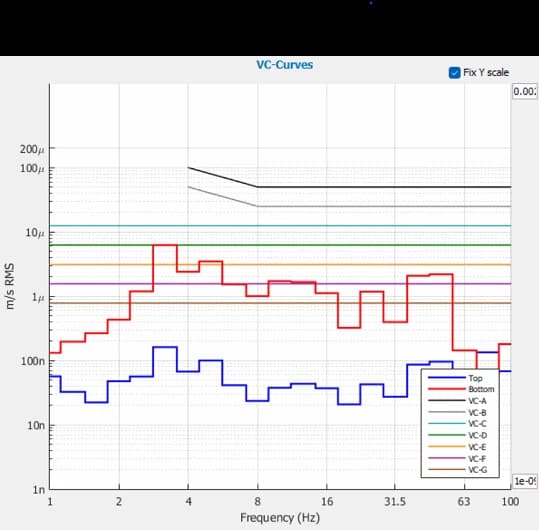
Data is represented in Autospectrum format, and reference material on the vibration level is provided.

Vibration Isolation System Information

Model: DVIA-ULFB700

Serial Number: 250107R2

Engineer

Juhyeok Kim, DAEIL SYSTEMS

Tuning Date

2026.05.18

End User

Kunming Metallurgical Research Institute Co., Ltd

Number of Tuning Trial

2nd

Site

Kunming

Equipment

Manufacturer: ZEISS

Equipment: FE-SEM

Model: Sigma 360

Vibration Specification

Vertical

Frequency [Hz]Allowable [mm/s² RMS]
1-80.03
8-450.15
45-1002

Horizontal

Frequency [Hz]Allowable [mm/s² RMS]
1-100.04
10-200.17
20-700.3
70-1002

Measurement Summary

Note: The allowable vibration values specified in the Zeiss Sigma 360 Site Preparation Guide are defined in terms of acceleration (mm/s² RMS). As the measurement data was acquired in velocity (m/s RMS), a direct comparison with the manufacturer's specification was not feasible. The acceleration-based specification was therefore converted to an equivalent velocity criterion, and the pass/fail evaluation was conducted against the converted values.

Measurement PointVibration SpecificationsAxisFloorDVIA-ULFB700
1. Floor
2. DVIA-ULFB700
See Section 9VerticalFAILPASS
Left to RightPASSPASS
Front to BackPASSPASS

Measurement Data

Vertical — Autospectrum

Left to Right — Autospectrum

Front to Back — Autospectrum

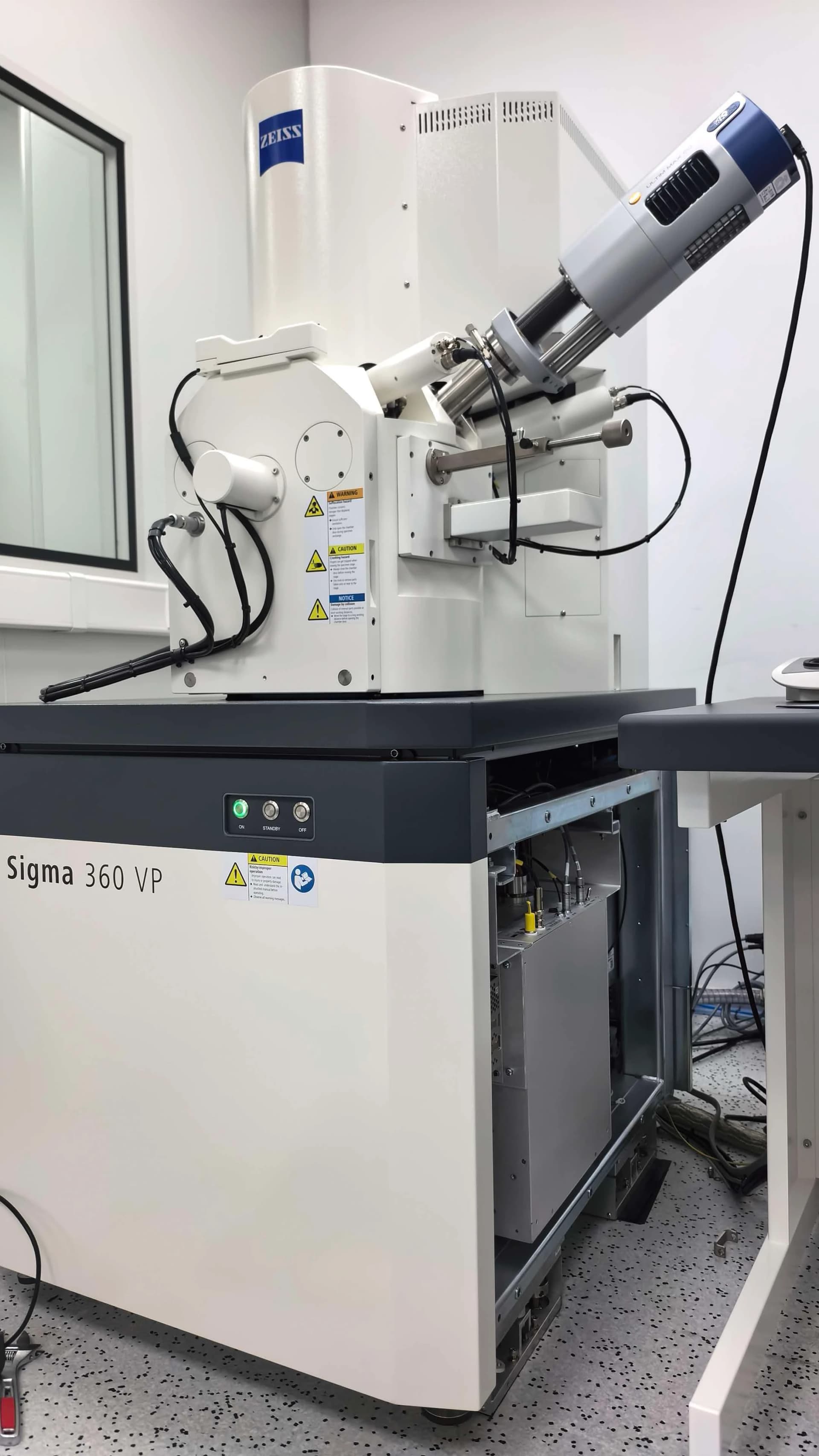
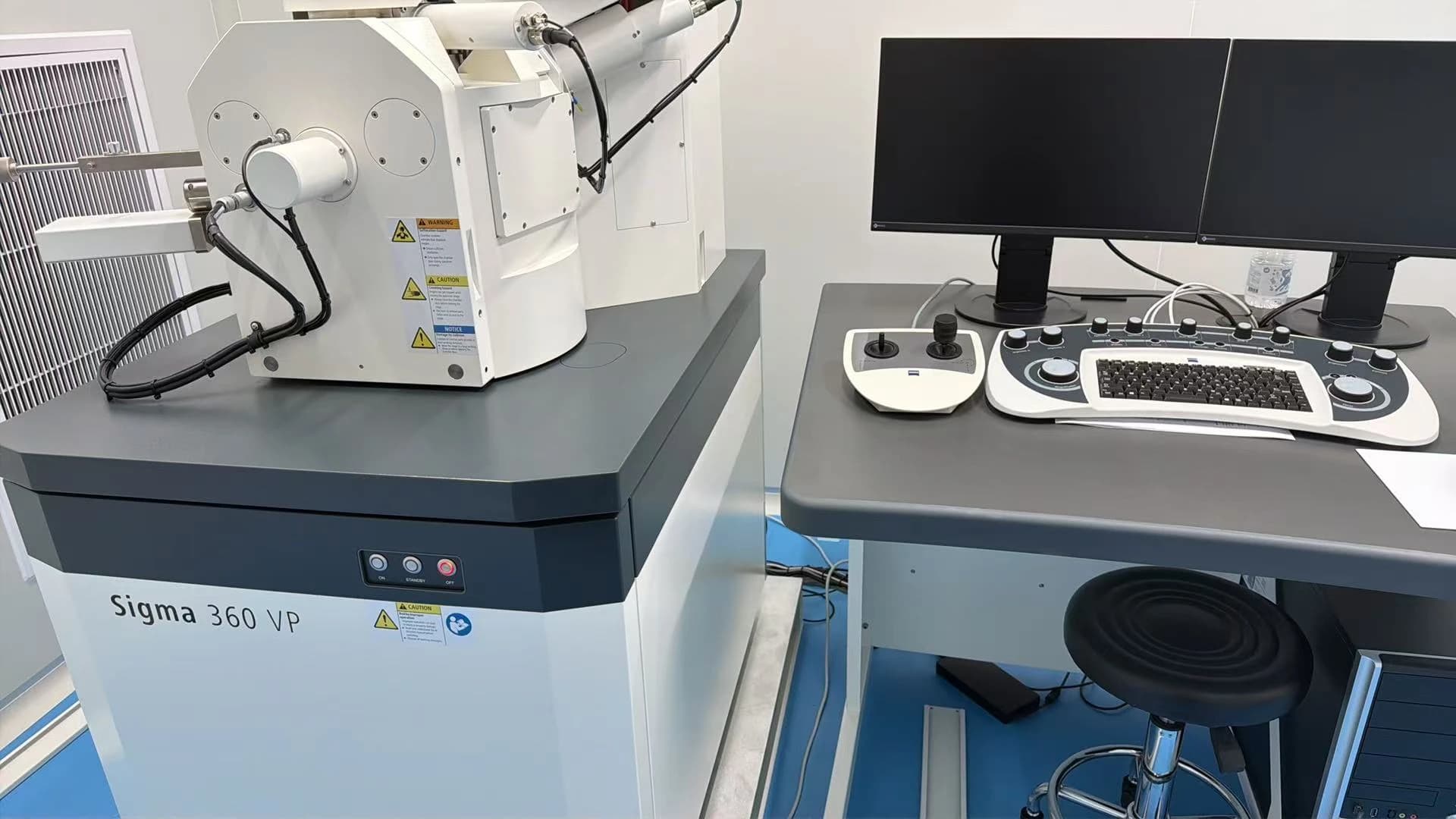
Equipment Photo

Reference

The table below classifies vibration levels based on IEST-RP-CC012.2.

Criterion CurveDescriptionAmplitude (μm/s) (μin/s)Detail Size (μm)
Workshop (ISO)Distinctly perceptible vibration. Appropriate to workshops and non-sensitive areas.800 (32,000)N/A
Office (ISO)Perceptible vibration. Appropriate to offices and non-sensitive areas.400 (16,000)N/A
Residential Area (ISO)Barely perceptible vibration. Appropriate to sleep areas in most instances. Usually adequate for computer equipment, hospital recovery rooms, semiconductor probe test equipment, and microscopes less than 40x.200 (8,000)75
Operating Theatre (ISO)Vibration not perceptible. Suitable in most instances for surgical suites, microscopes to 100x and for other equipment of low sensitivity.100 (4,000)25
VC-AAdequate in most instances for optical microscopes to 400x, microbalances, optical balances, proximity and projection aligners, etc.50 (2,000)8
VC-BAppropriate for inspection and lithography equipment (including steppers) to 3μm line widths.25 (1,000)3
VC-CAppropriate standard for optical microscopes to 1000x, lithography and inspection equipment (including moderately sensitive electron microscopes) to 1μm detail size. TFT-LCD stepper/scanner processes.12.5 (500)1-3
VC-DSuitable in most instances for demanding equipment, including many electron microscopes (SEMs and TEMs) and E-Beam systems.6.25 (250)0.1-0.3
VC-EA challenging criterion to achieve. Assumed to be adequate for the most demanding of sensitive systems including long path, laser-based, small target systems, E-Beam lithography systems working at nanometer scales, and other systems requiring extraordinary dynamic stability.3.12 (125)< 0.1
VC-FAppropriate for extremely quiet research spaces; generally difficult to achieve in most instances, especially cleanrooms. Not recommended for use as a design criterion, only for evaluation.1.56 (62.5)N/A
VC-GAppropriate for extremely quiet research spaces; generally difficult to achieve in most instances, especially cleanrooms. Not recommended for use as a design criterion, only for evaluation.0.78 (31.3)N/A

Notes:

1. As measured in one-third octave bands of frequency over the frequency 8 to 80 Hz (VC-A and VC-B) or 1 to 80 Hz (VC-C through VC-G).

2. The detail size refers to line width in the case of microelectronics fabrication, the particle (cell) size in the case of medical and pharmaceutical research, etc.

3. The detail size is not relevant to imaging associated with probe technologies, AFMs, and nanotechnology.
Share this Case Study

Case Study Information

Category
Installation Report
SeriesDVIA-ULF Series
Date05-21-2026
Tags
DVIA-ULF Series
Installation Report
Kunming Metallurgical Research Institute
ZEISS
Sigma 360
FE-SEM
DVIA-ULFB700
250107R2